Hunting Small Properties Effectively
On 5 to 20 acres your limiting factor is not deer, it is entry and exit. Hunt a small parcel two or three times a season, from the right wind, and it out-produces land ten times its size.

A note before the tactics. Property boundaries, safety zones, minimum distances from dwellings and roads, and the legality of any given setup are set by your state or country and vary enormously. Nothing here is legal advice and we do not give any. Read your own agency’s regulations and, where a boundary or a shooting lane is in question, confirm it with the landowner and the local warden before you hunt.
The short answer for anyone with permission on a small parcel: you are not short of deer, you are short of undetected entries. A 10-acre woodlot sits inside the home range of several deer that use it regularly, and the animals are already there. What kills small-property hunting is a hunter who walks in across the middle of the parcel four evenings a week and teaches every deer within a kilometre that the place is dangerous after 3pm.
Treat a small property as a limited resource. Three well-chosen sits beat thirty casual ones, and hunters who accept that consistently take good animals off ground that neighbours dismiss as too small.
Do the boundary work before the season
Small parcels are mostly edge, which means almost every setup is near a line you must not cross. Sort this out in daylight, in August, not in the dark on opening morning.
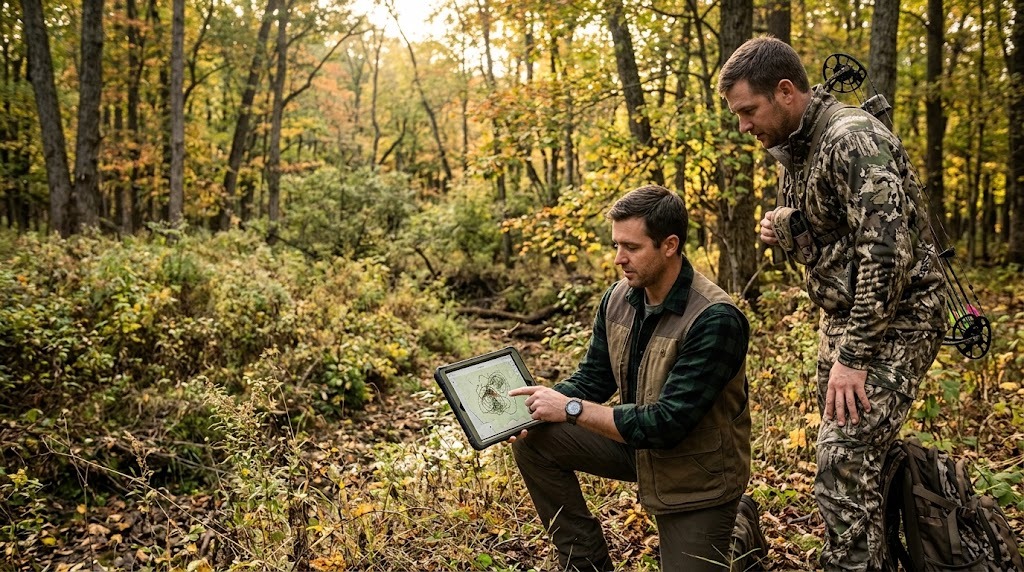
Walk the boundary with a mapping app and mark it, then check the marked line against actual physical evidence - fence, blaze, survey pin, old hedgerow. Mapping data is often 10 to 20m out, and that is enough to matter on a 5-acre block. Note where a wounded animal would most likely run, because on small ground that direction is usually onto someone else’s land, and the time to get a recovery agreement is before you need one, not at 9pm with a blood trail. Our guide on asking landowner permission covers how to have that conversation, and it is far easier to have it in advance.
Also identify every safety zone: houses, outbuildings, roads, footpaths, and the neighbour’s stand if you can see it. What is left after subtracting those is your actual huntable acreage, and it is usually smaller than the deed acreage by a good margin.
Access is the whole game
On big ground you can walk in badly and still recover, because there is somewhere else to go. On 10 acres there is nowhere else.
Plan the route before the stand. Pick where you want to sit, then work backwards and ask how you get there without crossing bedding, feeding areas, or the travel route you intend to hunt. If there is no clean route, that stand is the wrong stand, no matter how good the sign is.
Use whatever the property gives you as a screen. A creek bottom, a ditch, a standing crop, a fence line with thick cover, the back of a barn. Water is best if it is available, because it takes scent with it and leaves nothing on the ground. A field edge walked in the open at last light is the fastest way to burn a small parcel.
Getting out matters as much as getting in. Deer that catch you leaving after dark learn just as well as deer that catch you arriving. On small ground, many hunters deliberately sit later or leave earlier than they would elsewhere, purely to avoid walking through animals.
If you can drive to within 100m, use the vehicle. Deer tolerate vehicles far better than they tolerate a person on foot, and a truck door closing at the top of a field is a smaller event than a hunter walking the same distance.
Wind discipline, not wind luck
Small properties usually give you one or two viable wind directions, and hunting on any other wind is not a compromise, it is a waste of the sit.
Write down, for each stand, the winds that work. Then hunt only on those days. This is the discipline that separates people who kill deer on small parcels from people who hunt them constantly and see nothing after the first week. A stand hunted three times on the right wind will out-produce the same stand hunted fifteen times on whatever the day offered.
Note that thermals often beat forecast wind on small ground, especially in the first and last hour. In hilly terrain, cool air slides downhill at first light until the sun warms the slopes, thermals rise uphill through the day, and in the last hour they sink downhill again as the ground cools - regardless of what the app says. Our wind and scent control guide goes into the practical detail.
Give deer a reason to stay
A small property does not need to hold deer all day. It needs to be attractive at the specific hour you can hunt it.
Cover beats food on most small parcels. If the neighbours have crops and you have a thicket, you hold the more valuable asset, because bedding cover is scarcer than food in most agricultural landscapes. Resist the urge to tidy. Standing brush, blowdowns, and a section you simply never walk into are worth more than anything you could plant.
Create a sanctuary and mean it. Fence off a third of the parcel, mentally, and never enter it. No stands, no cameras, no shed hunting, nothing. Deer need a place where they are never disturbed, and if you provide the only one in the neighbourhood, they will use your ground during daylight.
Water is underrated where it is scarce. A small pond or a maintained wet spot can be the highest-traffic feature on a dry parcel in early season.
Where food plots or supplemental feeding are legal in your area - and in many places they are not - keep them small, keep them screened, and place them so the approach favours you rather than the deer. Check your own regulations first, because feeding rules change frequently and often mid-season.
Setups that suit tight ground
Small parcels reward setups you can access quietly and use once or twice, not permanent towers on the field edge.
Ground blinds work well because they hide movement in thin cover and can be brushed in and left to weather for several weeks before use, and the ground blind setup guide covers the placement side. Where a tree stand suits the ground better, keep it tight to the entry route and follow the harness practices in tree stand safety - and be aware that on small ground your safe shooting angles are narrower than usual, because a downward shot that misses still has to land somewhere on your property.
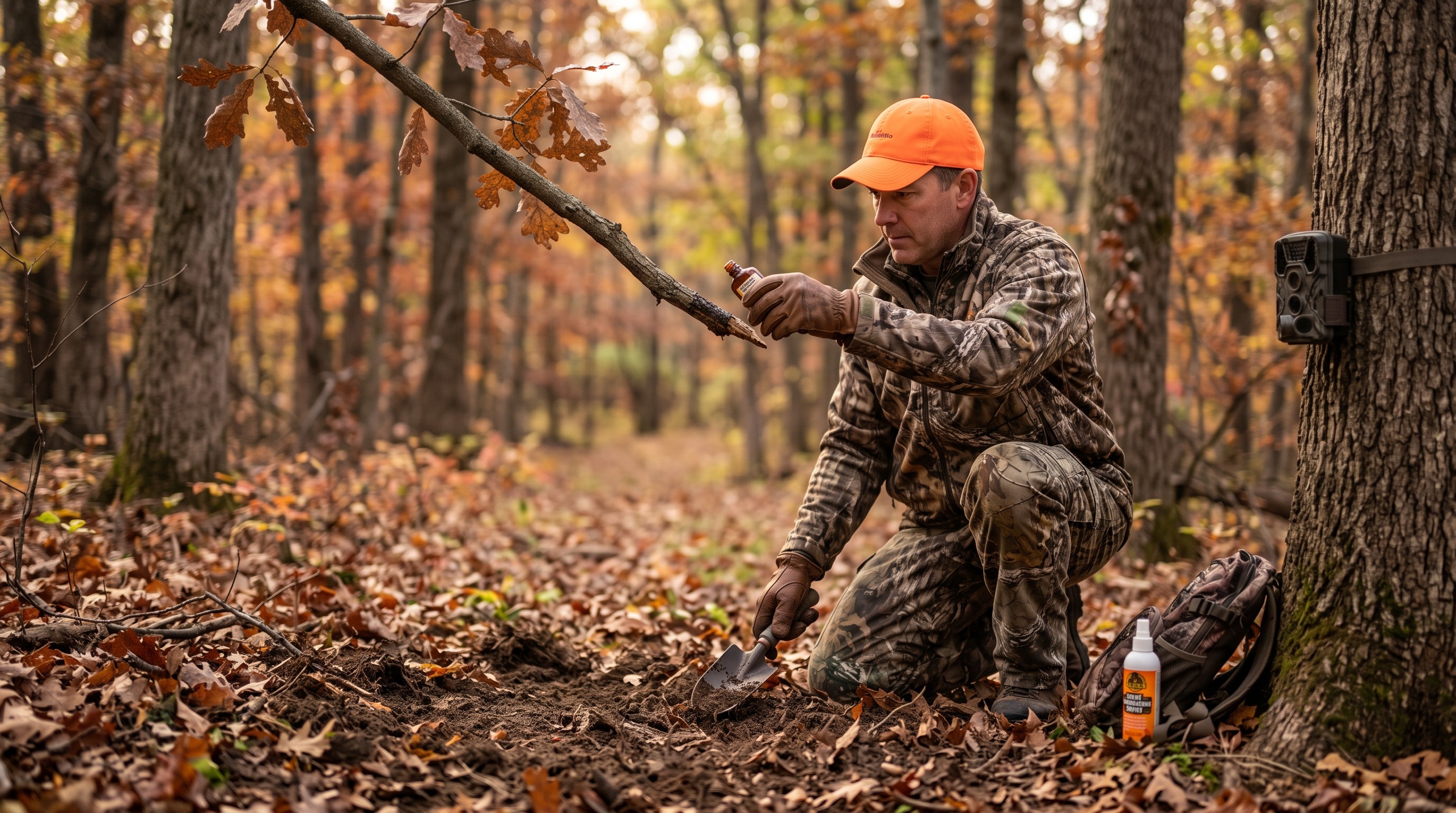
Keep camera use light. Cell cameras avoid repeated trips, but even those need placement along your access route rather than deep in the parcel. Every trip to swap a card is a hunt you spent without a weapon in your hand. Trail camera placement has more on the trade-off.
The realistic expectation
A well-managed 10-acre parcel in decent habitat will give you perhaps four to eight genuinely good sits in a season, concentrated around the right wind and the right phase of the rut. That is enough. Treat those sits as the finite resource they are, sit out the wrong days without guilt, and the small property stops feeling like a limitation.
🛒 Recommended Gear on Amazon
- Wind checker powder - browse current options and reviews on Amazon.
- Lock-on treestand - browse current options and reviews on Amazon.
- Climbing sticks - browse current options and reviews on Amazon.
As an Amazon Associate, we earn from qualifying purchases - at no extra cost to you. This helps us keep producing free, in-depth guides.