How to Ask Landowner Permission
Knock in August, not October. Ask in person, ask for something small and specific, and put nothing on the land until you have a clear yes - here is how private-land access actually gets granted.
A note before you start. Access rules, trespass law, written-permission requirements and liability arrangements are set by each state and sometimes by county, and they differ considerably. This article is a reading guide to the etiquette of asking - it is not legal advice and we do not give any. Your state wildlife agency’s regulations and, for anything involving written agreements or liability, a qualified attorney in your state are the final word.
Ask in person, ask early, ask for something small and specific, and accept a no gracefully. That is the entire method, and it works far more often than people expect - by most accounts somewhere between one in four and one in three doors produce a yes, which is a better hit rate than almost anything else in hunting. The reason it feels impossible is that most hunters ask in the first week of October, ask for everything, and ask by text.
August is the month for this. The season is far enough off that you are not an inconvenience, the landowner is not yet fielding a knock a day, and there is still time to build the kind of relationship that turns one season of access into ten.
Do the homework before you knock
Turning up unprepared wastes the one chance you get.
- Find out who actually owns it. County parcel maps and assessor records are public in most states, and several mapping apps used for scouting show ownership layers. The person farming a field is often not the person who owns it, and asking the wrong one puts you back at the start.
- Check whether the parcel is enrolled in a state access programme. Many states lease private ground for public hunting, and that ground already has rules - and no need for a knock.
- Know the ground. Size, access points, what is growing, where the buildings sit. It shows you are serious and it makes the conversation concrete.
- Know what you are asking for. “Can I hunt?” is a vague, alarming question. “Could I bowhunt the timber on the north end, on foot, four or five mornings in October?” is a small one that is easy to say yes to.
The knock itself
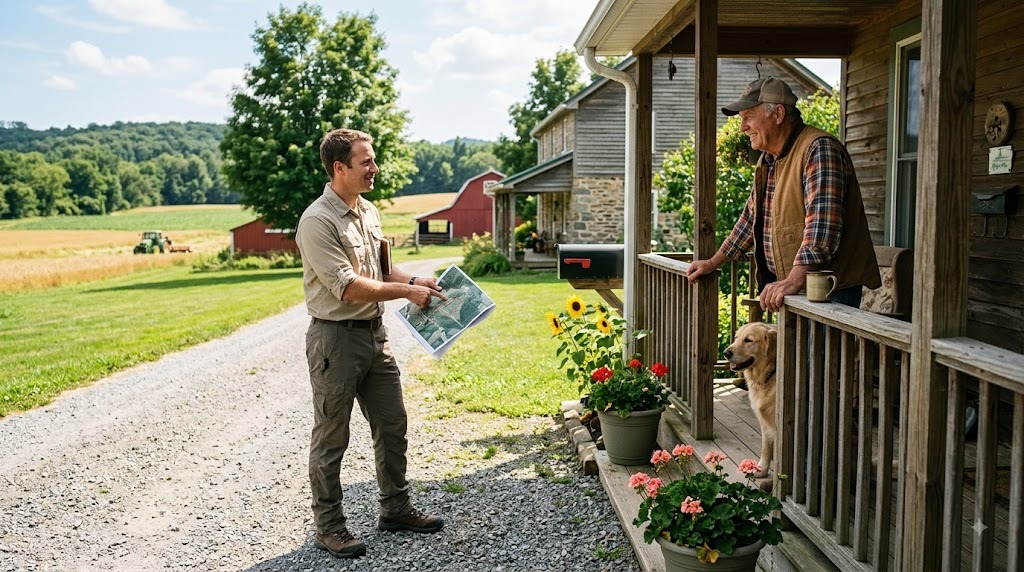
Go mid-morning or early evening on a weekday, alone, in ordinary clothes - not full camo, which reads as presumptuous. Park where you are visible, at the end of the drive rather than up by the house. Leave rifles, bows and dogs at home.
Then:
- Introduce yourself with your full name and where you live. Vagueness is what makes people nervous.
- Say why you are there in one sentence, and say that you are asking early, before the season.
- Ask a narrow question. One species, one method, a rough number of days, on foot. You can widen it in later years.
- Offer a way to say no. “I completely understand if you already have people on it” removes the pressure and, oddly, makes a yes more likely.
- Take the answer at face value. A no is a no. Thank them, leave a card with your phone number, and go. A polite exit is why some of those doors open two seasons later.
- If it is a yes, ask what the rules are rather than assuming: where to park, which gates, whether vehicles are allowed, whether other hunters are on the ground, when they would rather you were not there.
Bring a printed card with your name, phone number, vehicle description and licence details. It costs almost nothing and it separates you from everyone else who has knocked that month.
What landowners are actually worried about
Understanding the objections makes the conversation easier, because most of them are reasonable.
- Liability. This is the big one. Many states have recreational-use statutes that limit an owner’s liability for people permitted on their land without charge, but the details vary and owners are often unclear on them. Do not lecture them about it - point them to their own attorney and offer to sign whatever they want signed.
- Gates, ruts and livestock. A gate left open or a truck through a wet field ends access permanently, and every owner has that story.
- Damage and litter. Screw-in steps in a valuable tree, ruts, wire cut, cans left behind.
- Not knowing who is out there. Owners want to be able to look at a vehicle and know whose it is.
- Being asked for too much. A request to run a camp, bring four friends and take a buck reads as a takeover. A request for a few solo mornings does not.
Address the first four before you are asked and you have answered most of the reasons people say no.
Once you are on the ground
Access is renewed every season by conduct, not by the original conversation.
- Text or call before every single visit, even after five years. This is the single most common reason permission gets withdrawn.
- Follow the gate rule exactly - leave every gate as you found it, open or closed.
- Park where you were told, drive slowly, and stay off wet ground.
- Leave nothing. Take stands and cameras out at the end of the season unless you were told otherwise, and pick up other people’s litter while you are at it.
- Report what you saw. Trespassers, a broken fence, a downed limb across a lane, sick or dead livestock. Being useful is what makes you worth keeping.
- Never bring anyone who was not agreed. Not a friend, not a brother-in-law, not “just for one morning”.
- Tell them how it went, including a photo if you took an animal on their ground. Owners like knowing.
And the part that matters most: help without being asked. A day of fence work in spring, a hand at harvest, snow cleared from a drive. The hunters who keep access for decades are almost always the ones who show up in months when there is nothing to hunt.
Do not offer money unless they raise it. Paid access is a different arrangement with different expectations, and offering cash to someone who was thinking of it as a favour can end the conversation cold. A genuine thank-you at the end of the season is standard and welcome - keep it modest and personal rather than transactional.
Written permission and paperwork
Several states require written landowner permission to hunt private ground, and some require it to be carried in the field. Others require it only for specific activities, and some not at all. Check your own state’s regulations before the season rather than assuming - your state wildlife agency publishes this, and many provide a standard permission form you can print.
Even where it is not required, a short written note helps everyone. It gives the owner a record, it gives you something to show a warden, and it forces the details - dates, species, method - to be stated rather than remembered differently later. If a landowner wants anything more formal than that, including a lease or a liability waiver, that is the point to involve an attorney in your state rather than a template from the internet.
If the doors are not opening
Some areas are genuinely locked up, and no amount of etiquette changes that. Widen the search rather than pushing harder: state access programmes that pay owners to allow hunting, smaller parcels that nobody else bothers to ask about, non-hunting owners with a nuisance problem, and the substantial public ground most hunters write off without walking. Ask about the small awkward corners - the 40 acres behind a subdivision, the woodlot too steep to farm. Those get asked about far less than the big obvious farms.
Keep a list, mark the parcels you have asked about and the date, and try again next August. Ownership changes, tenants change, and the answer that was no in 2026 is often yes in 2028 - but only for the person who asked politely the first time. Whatever ground you end up on, the same rules of conduct apply, and our piece on hunting ethics and conservation covers the wider version of them.