Blood Trailing A Wounded Deer
Most lost deer are lost in the first twenty minutes, by pushing too soon and by walking on the sign. Here is how experienced trackers read the hit, how long they wait, and what the rules actually allow.
Please read this first. Recovery is one of the most heavily regulated parts of hunting and the rules are local. Whether you may use a tracking dog, cross a property line to recover, track after legal light, carry a firearm while tracking, or how quickly you must tag an animal all vary by state, province and country, and they change. Your wildlife agency’s current regulations and the landowner are the authorities here, not an article. This piece describes how experienced trackers approach the problem. It is not legal advice and we do not give any.
The short version: most deer that are hit and never found were lost in the first twenty minutes, and almost always for one of two reasons. The hunter got down too soon and pushed a bedded animal that would have died within a hundred yards, or the hunter and their friends walked up the trail and destroyed the sign they were about to need. Almost everything else in tracking is recoverable from. Those two are not.
So the discipline that matters most is the boring one: mark where the deer stood, mark where you last saw it, sit back down, and think before you move.
What happened at the shot
The first evidence you get is the animal’s reaction, and it arrives before any blood does. It is worth writing down while it is fresh, including the time.
These are tendencies, not rules - individual animals break every one of them, and adrenaline makes hunters remember reactions that did not happen:
- A hard kick of the back legs is often associated with a heart or high-chest hit, and such deer frequently run hard and short.
- A hunched back and a slow, humped-up walk often accompanies a hit far back, in the liver or paunch area. These animals frequently bed quickly and nearby if they are not pushed.
- A flinch or a flat, level run with no other reaction is the least informative and the most often misread. It can mean a clean pass through, a marginal hit, or a clean miss.
- A stumble or an immediately dropped leg points at bone or muscle rather than vitals.
Note the exact spot the deer was standing and the exact point it entered cover. Pick landmarks that will still be identifiable in fading light or in the dark - a snag, a rock, a fence post - because the woods look completely different at eye level than they did from the stand. Marking both points before you climb down is the single highest-value thing you can do.
Waiting, and why it is not one number
The wait exists because a wounded animal that is left alone lies down and stops. The same animal pushed will keep going, often for miles, and the wound clots as it travels.
Common practice, roughly:
- A clear double-lung or heart hit with heavy immediate sign - many hunters give it 20 to 30 minutes, and these deer are usually down inside 100 yards.
- A single lung or otherwise marginal chest hit - several hours is common practice rather than the half hour a good hit gets.
- A liver hit - typically four to six hours. Liver hits are almost always fatal and almost always ruined by impatience.
- A paunch or gut hit - eight to twelve hours, and many trackers will simply wait until the following morning. These animals bed close and die, if they are not moved.
- A muscle-only hit - the honest answer is that many of these deer survive, and pushing one hard accomplishes nothing except a longer chase.
Real conditions override the table. Warm weather spoils meat quickly and shortens what a long wait can afford you - our field care and aging tool shows how fast that window closes above about 40F. Rain that is about to wash out the sign argues for starting sooner. Coyote pressure in some areas argues the same way. Legal light, whether you may track after dark where you hunt, and getting permission before crossing a boundary all come first, and none of those are decisions to make in the dark on the spot - our guide to asking landowner permission covers doing that conversation in advance rather than at 10pm.
Reading the first sign
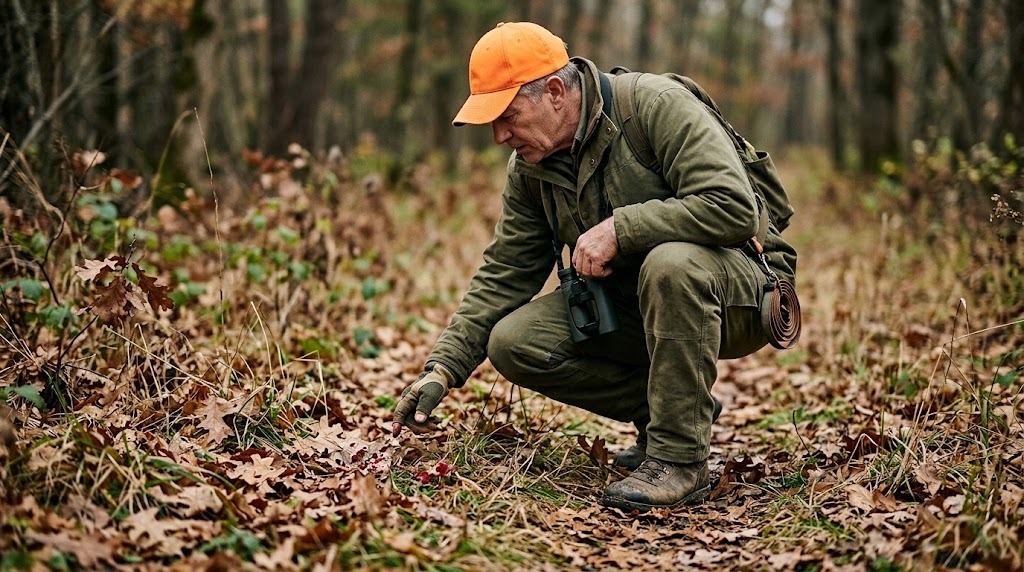
Start at the exact spot the deer stood, not where you think it went. Look for the arrow or the impact site, hair, and the first blood.
Hair tells you a lot before blood does. Coarse, dark, hollow hair with black tips usually comes from the back and upper body. Lighter brown hair with dark tips is typically side and rib area. White hair is low chest or belly. Short, fine hair often comes from the legs.
Blood colour and content narrows it further. Bright red blood with visible bubbles or froth is associated with lungs. Uniform bright red suggests muscle or artery. Very dark red or maroon is often liver. Blood mixed with green or brown matter, with a distinct smell, means the digestive tract - the hit that demands the longest wait. Blood with bone fragments or marrow suggests a leg.
An arrow, if you are bowhunting, is the best single piece of evidence available and is worth finding before anything else. The hunter’s judgement of shot placement in the moment is far less reliable than most of us like to believe, so let the physical evidence argue with your memory and be willing to lose that argument. Our shot placement reference is a useful anatomy check when you are trying to reconcile the two.
Trailing without destroying the trail
The mechanics matter more than most people expect:
- Never walk on the blood line. Track to one side of it. If the trail dries up, you will need every one of those marks to work back and start again.
- Mark last blood every time, with flagging tape, tissue or a pin on your GPS. The string of marks shows you direction of travel, which is the thing that finds the deer when individual drops run out.
- One or two trackers, not five. More people means more sign trampled and more noise.
- Look ahead as well as down. Blood on the sides of brush at knee and waist height, disturbed leaves, and skid marks in soft ground carry the trail through stretches with nothing on the ground.
- Go slow and stay quiet. If the animal is still alive and bedded ahead of you, your best outcome depends entirely on not startling it.
- Use low, oblique light. A light held low and swept across the ground shows blood that overhead light washes out. Dew makes early sign much easier to see; hard rain removes it.
When the blood runs out
It usually does. Wounds clot, blood goes internal, and the trail simply ends.
Go back to the last confirmed mark and work outward from there rather than wandering forward on a hunch. From the last known point, consider that wounded animals commonly go downhill, head for the thickest cover available, follow the path of least resistance along trails and contours, and are often drawn toward water. Grid the likely cover slowly and systematically, and check every blowdown, ditch and thicket properly rather than glancing at it.
If you have permission and it is legal where you hunt, a trained tracking dog recovers animals that people cannot, and using one is not an admission of a bad shot. Legality varies enormously - some places allow leashed dogs freely, others restrict the practice or ban it, and some require a permit - so this is a thing to research before the season rather than at midnight.
The part that is not technique
Some animals are not recovered. That happens to careful, experienced hunters, and the honest response is to spend the effort the animal is owed, then to look hard at what went wrong - range, rest, angle, equipment, or the decision to take the shot at all. Confirming zero before the season and being conservative about the shots you decline are what actually reduce this, far more than tracking skill does. Our ethics and conservation guide covers the broader responsibility, and how to field dress a deer picks up where a successful recovery ends.
Where the law requires reporting a wounded animal, or restricts tagging and possession, that comes from your agency’s current regulations. Check them before opening day, not after the shot.