Virginia Rail
The Virginia Rail is a small, secretive freshwater-marsh bird and a legal migratory game bird across much of the US, though it draws far less hunting pressure than ducks or even its frequent companion, the Sora.
🗓️ Last reviewed: July 2026
Overview
The Virginia Rail is a small, secretive freshwater-marsh bird and a legal migratory game bird across much of the US, though it draws far less hunting pressure than ducks or even its frequent companion, the Sora. Weighing only a few ounces and preferring to run through cattails rather than fly, it offers challenging, low-key early-fall wingshooting for hunters willing to wade thick cover.
Identification & Appearance
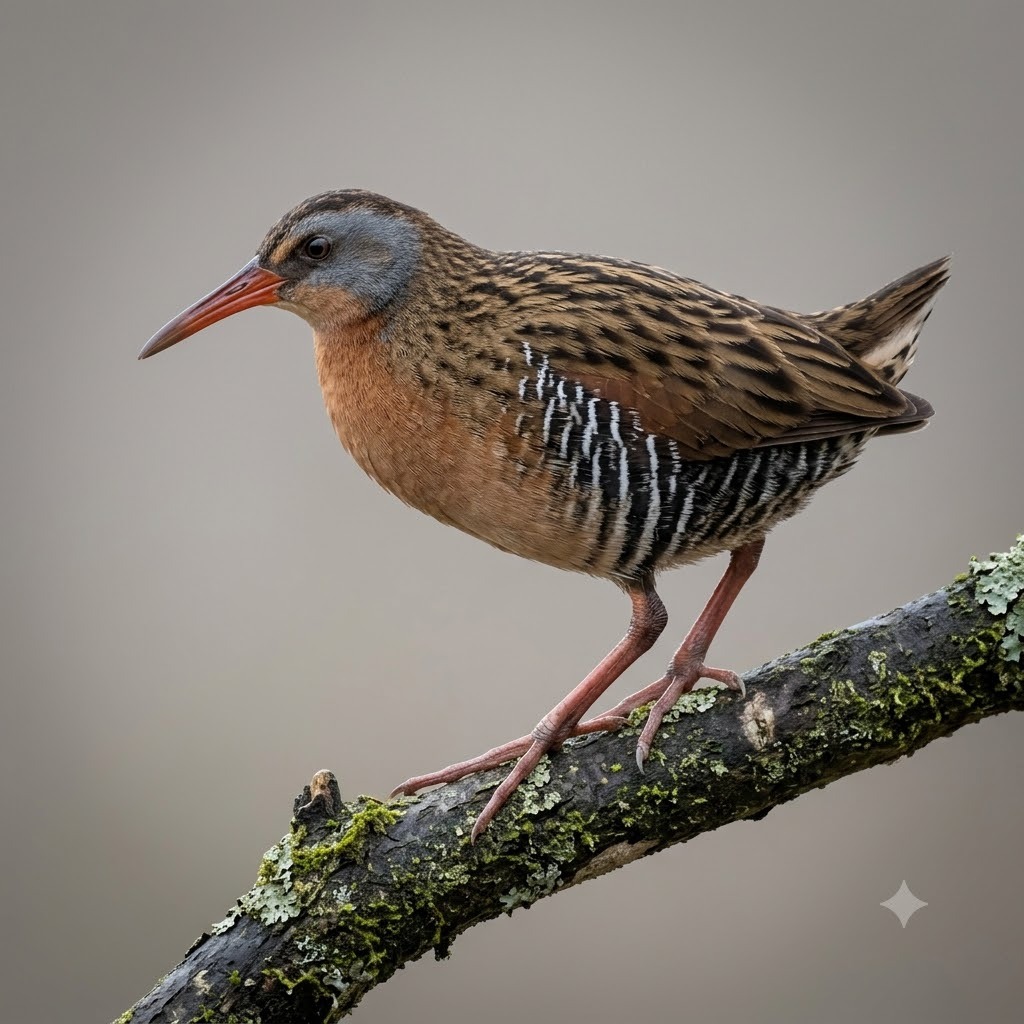
Adults show a rusty-cinnamon breast, gray cheeks, black-and-white barred flanks, and a long, slightly downcurved reddish bill with reddish legs. It is easily confused with the smaller Sora, which has a short stubby yellow bill and a black face. At roughly 8-11 inches long and only about 2.5-3 ounces, it is a laterally compressed bird built to slip between reed stems.
Range & Habitat
Virginia Rails breed across the northern and central US and southern Canada, wintering in the southern US, coastal marshes, and Mexico. They favor freshwater and brackish marshes thick with cattail, bulrush, and sedge, usually near shallow water and exposed mud. They rarely stray far from dense emergent cover.
Behavior & Sign
This rail would rather run than fly, flushing only when nearly stepped on, then fluttering weakly a short distance before dropping back into the reeds. It is most vocal at dawn and dusk, giving a descending grunt series and a metallic "kid-ick." Look for narrow runways through matted vegetation and small tracks in soft mud.
Hunting Seasons & Timing
Rail seasons typically fall in September and October under the federal migratory bird framework, often overlapping early teal or duck seasons. A cool early-fall morning during migration, when birds stage in numbers, is prime. Dates - and whether your state opens a rail season at all - vary widely, so confirm current regulations.
Hunting Methods
The classic method is wading or slowly pushing a shallow-draft boat through marsh cover to flush birds, ideally on a higher tide or in flooded vegetation that concentrates them. A close-working flushing dog greatly helps find both live and downed birds. Shots are close and quick.
Gear & Optics
No optics are needed for this close-range wingshooting. An open-choked shotgun (improved cylinder or skeet) with small nontoxic shot such as steel #6 or #7 is ideal, and many wetlands require nontoxic shot, so check first. Add waders and a marsh-capable dog.
Shot Placement & Field Care
Take the flushed bird as a close going-away target and center the pattern on the body; heavy loads are unnecessary. Recover birds quickly, since they vanish easily in dense marsh. Field-dress and cool promptly, as a small bird spoils fast in warm early-season weather.
Meat & Eating Quality
There is little meat on a rail - mostly two small dark breast fillets - but it is mild and generally well regarded, similar to other dark-meated game birds. Because the yield per bird is tiny, plan on several birds for a meal. A quick pan-sear suits the breasts best.
Common Mistakes
The most serious mistakes are misidentifying the bird or confusing it with protected marsh species, and failing to recover downed birds in heavy cover. Hunters also overlook nontoxic-shot rules and required HIP registration. Do not overestimate how much one small bird will feed you.
Regulations & Conservation
Virginia Rail populations are considered stable and the species is listed as Least Concern; it is legal to hunt under the Migratory Bird Treaty Act framework where states offer seasons. You typically need a state license and HIP certification and must follow nontoxic-shot and bag-limit rules; daily limits are often generous (commonly 25 Virginia Rail and Sora combined) but vary by state. Never shoot at a rail you cannot positively identify.
FAQ
Q: Do I need a federal duck stamp to hunt Virginia Rail? Generally no - the duck stamp covers waterfowl, but you do need a state license and HIP registration, plus any state migratory bird permit. Confirm locally.
Q: Is the Virginia Rail endangered? No. It is listed as Least Concern with stable populations, but you must still avoid confusing it with protected or restricted marsh species.
Q: How much meat comes off one bird? Very little - mostly two small dark breast fillets, so plan on several birds for a single meal.