Harlequin Duck
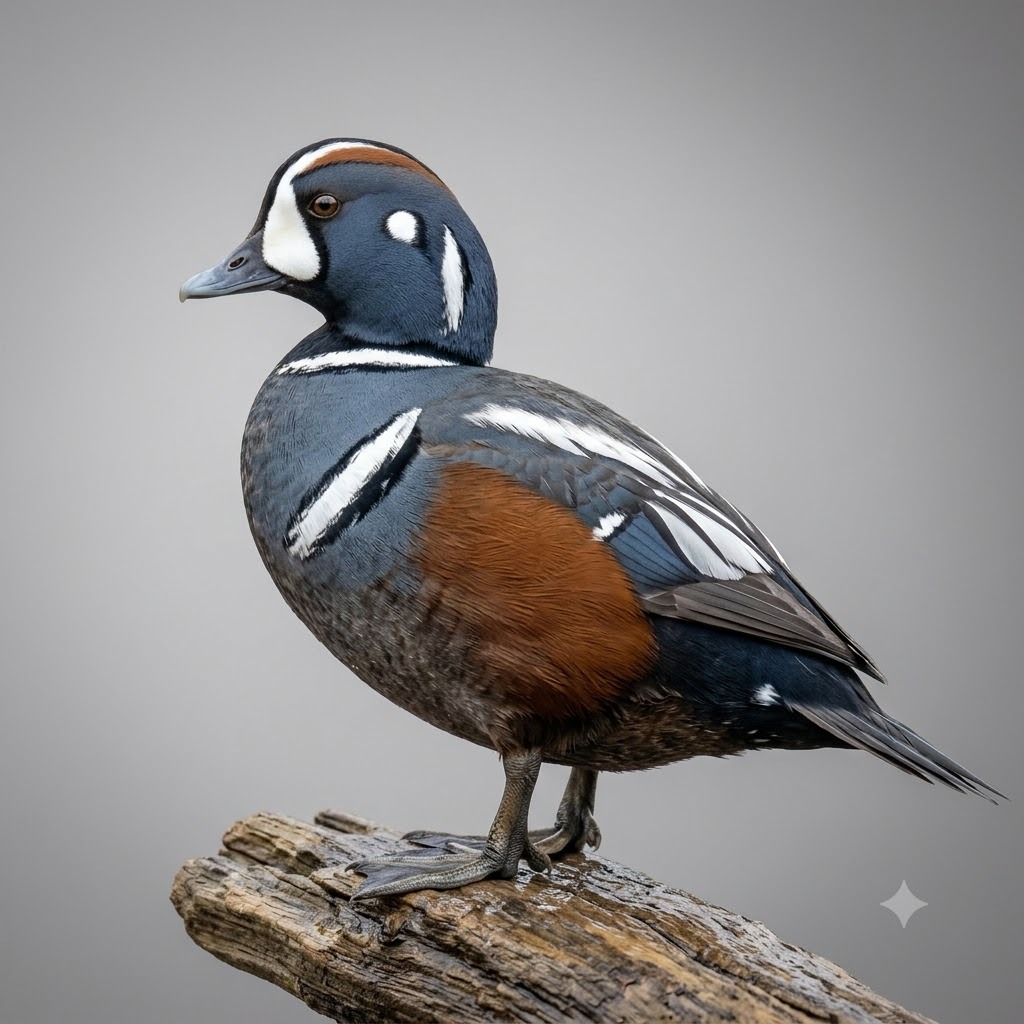
The harlequin duck is a small, hardy sea duck named for the drake's clownish, painted plumage (Histrionicus means "theatrical" or "actor-like").
🗓️ Last reviewed: July 2026
Overview
The harlequin duck is a small, hardy sea duck named for the drake's clownish, painted plumage (Histrionicus means "theatrical" or "actor-like"). It thrives in punishing water: fast mountain rivers in summer and wave-battered rocky coasts in winter. For US hunters it is a legal but tightly restricted quarry, taken mainly in Alaska and parts of the Pacific Flyway, while the small eastern population keeps Atlantic seasons closed.
Identification & Appearance
Drakes are unmistakable: a slate-blue body, rich chestnut flanks, and bold white crescents, spots, and stripes each outlined in black. Hens and juveniles are plain brown with two or three round white patches on the face, easily confused with female buffleheads or scoters. It is a small duck, roughly a pound and a half, with a short bill and a compact, buoyant profile.
Range & Habitat
Two separate North American populations exist: a large Pacific group from Alaska south along the coast, and a small, sensitive Atlantic group in eastern Canada and rarely the northeastern US. Breeding birds nest along swift, clear mountain streams, while wintering birds cling to exposed rocky headlands, jetties, and surf zones. They rarely stray far from turbulent water.
Behavior & Sign
Harlequins are strong divers that feed in surf and rapids on crustaceans, mollusks, and insect larvae, popping up between waves. They gather in small, tight rafts and are strongly site-faithful, returning to the same rocks year after year. They are often surprisingly approachable, which makes conservative harvest essential.
Hunting Seasons & Timing
Where legal, harlequins fall under sea duck seasons, typically fall through winter along the coast. Bag limits are extremely small, often just one harlequin per day or per season where any harvest is allowed at all. Many states and the entire Atlantic Flyway keep the season closed, so always confirm current state and flyway rules first.
Hunting Methods
Most harlequins are taken incidentally by sea duck hunters decoying or pass-shooting over rocky open water from a boat or shoreline. Because the birds hug rough, rocky coastlines, hunts demand seaworthy craft and calm judgment. Deliberately targeting harlequins is discouraged given their small numbers; treat any bird as a rare bonus, not a goal.
Gear & Optics
A 12-gauge with non-toxic shot (steel BB to 2, or denser tungsten) handles tough, well-feathered sea ducks. Bring a reliable retriever or boat, warm waterproof layers, and a PFD, because cold water and surf are the real danger. Binoculars help you positively identify hens and juveniles before you shoot.
Shot Placement & Field Care
Take clean, in-range shots and be ready for cripples, since sea ducks dive hard when hit. Retrieve quickly in the surf before a wounded bird slips away. Field-dress promptly, cool the carcass fast, and leave a wing attached if regulations require species identification at check.
Meat & Eating Quality
Like most shellfish-eating sea ducks, harlequin meat is dark and can taste strong or fishy. Skinning, trimming fat, and soaking or brining help, and slow braises or grinding into sausage suit it better than a quick sear. Honestly, it is table fare of last resort for most hunters.
Common Mistakes
The biggest error is shooting a harlequin where the season is closed or the limit is already filled, since penalties are steep. Misidentifying a brown hen as a scoter or bufflehead is common, so verify before firing. Underestimating cold, rocky surf leads to lost birds and real danger.
Regulations & Conservation
Harlequins require a federal duck stamp, state license, HIP registration, and non-toxic shot, plus any special sea duck endorsements. The eastern population is small and listed as a species of Special Concern in Canada, which is why Atlantic hunting stays closed and the Pacific population supports only a token harvest. Their slow reproduction and strong site fidelity make them easy to overharvest locally, so hunt them conservatively and legally, or pass.
FAQ
Q: Can I legally hunt harlequin ducks in the US? Yes, but only in limited areas, mainly Alaska and parts of the Pacific Flyway, usually with a one-bird limit; the Atlantic Flyway season is closed. Always check current state regulations.
Q: Are harlequin ducks endangered? Not federally listed in the US, but the eastern North American population is small and treated as a conservation concern, so seasons there are closed or absent.
Q: Do they taste good? Generally no, because their shellfish diet makes the meat strong and fishy; heavy trimming and slow cooking are needed.