Addax
The addax is a pale desert antelope of the Sahara that is kept in the United States in captive herds, including on Texas ranches, and that U.S. federal law lists as endangered.
Last reviewed: November 2026
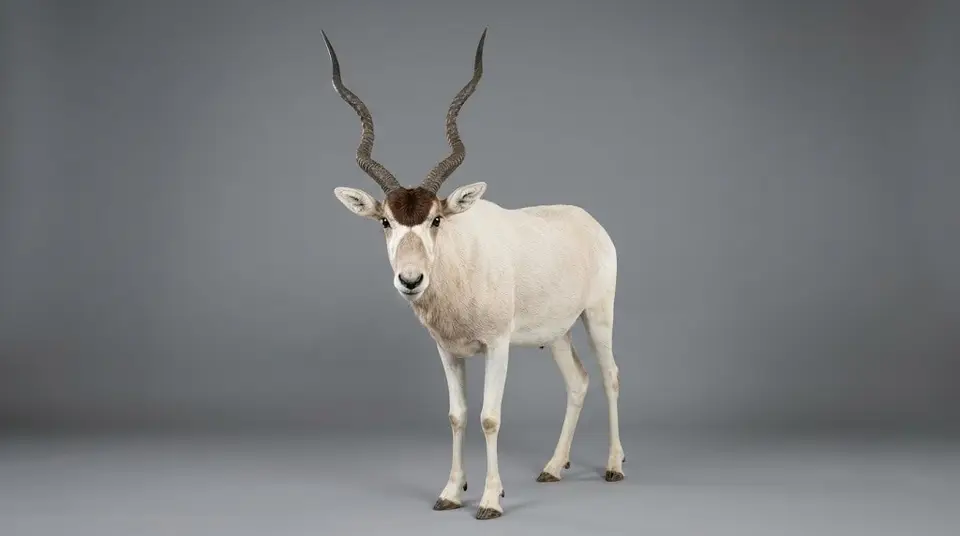 AI illustration
Overview
The addax is a pale desert antelope of the Sahara that is kept in the United States in captive herds, including on Texas ranches, and that U.S. federal law lists as endangered. On the U.S. list of endangered and threatened wildlife, the addax is listed as Endangered wherever found (50 CFR 17.11), and in its 2005 listing rule the U.S. Fish and Wildlife Service described the species as nearly extinct in the wild, with probably fewer than 600 animals left (70 FR 52319). In the United States, a special federal rule allows sport hunting of U.S. captive-bred addax under set conditions (50 CFR 17.21).
An addax hunt is therefore possible only where it is legal under the federal rules for endangered wildlife (50 CFR 17.21); the FAQ and the regulations note below explain those rules. The Animal Diversity Web (ADW) describes the addax as the most desert-adapted antelope.
Identification & Appearance
Adult addax stand 95 to 115 cm at the shoulder and weigh 60 to 125 kg (132 to 275 lb), according to the Animal Diversity Web, which adds that males are slightly larger than females. ADW describes a coat that is sandy to almost white in summer and grayish brown in winter, white markings on its face, ears, belly, hips and legs, a black tuft of hair on its forehead, and widely splayed hooves suited to walking on desert sand (ADW).
Both sexes carry horns, which ADW says average about 72 cm in length with roughly 1.5 to 3 spiral twists (ADW); the 2005 federal listing rule gives horns that twist in a spiral up to 43 inches (109 cm) long and describes the coat as grayish white (70 FR 52319). In captivity, addax can live up to 25 years (ADW).
Range & Habitat (US)
In the United States, addax live in captive herds at zoos and on private ranches; the U.S. Fish and Wildlife Service credits breeding programs at both with raising their numbers. In Texas, the Service's 2005 rule, citing Mungall (2004), counts ranched addax rising from 2 animals in 1971 to 1,824 in 1996, growth it attributes mostly to breeding on the ranches, with some captive-bred founder animals brought in (70 FR 52310). A 2010 census of its members by the Exotic Wildlife Association, cited by the Service in 2014, put 5,112 addax on member ranches, while the Sahelo-Saharan Interest Group's estimate from the time of the 2005 listing was 1,500 addax in captivity worldwide (79 FR 15250); the two figures come from different years and different counters.
In the wild, ADW's account, last updated in 2000, gives the former range as the deserts and semideserts between Western Sahara and Mauritania in the west and Egypt and Sudan in the east, and the range at that time as desert parts of Chad, Libya, Mali, Mauritania, Niger and Sudan (ADW). The addax does not depend on free water and is usually found in the desert or the stony country around it (ADW), and the 2005 federal rule traces its decline from a range across the Saharan region in the 19th century, with the greatest losses coming from motorized uncontrolled killing after World War II (70 FR 52319).
Behavior & Sign
ADW describes herds of about 5 to 20 animals, each headed by a dominant adult male; males try to hold territories with fertile females, and among females the oldest rank highest (ADW). The addax is active by day, eats desert grasses and scrub and travels great distances for sparse plants, and ADW notes that it goes most of its life without drinking, getting its water from the plants it eats (ADW). ADW also describes it as a slow runner on short legs that cannot reach very high speeds (ADW).
Breeding season
ADW says addax can breed in any month, most often in spring, with births peaking in winter and early spring (ADW). It gives a gestation of 257 to 264 days, nearly always ending in a single calf that is weaned at 23 to 39 weeks, and puts sexual maturity at about 24 months in males and in the second or third summer in females (ADW).
Checked: 14 November 2026.
Hunting Seasons & Timing
In the United States an addax hunt falls under the federal rules for endangered wildlife, including a special rule for U.S. captive-bred addax in 50 CFR 17.21(h). That rule allows the take of U.S. captive-bred addax, sport hunting included, only when the purpose helps increase or sustain captive numbers or a possible return of animals to the range countries, and only if the operation manages its herd to prevent hybridization and keep genetic diversity and keeps accurate written records of births, deaths and transfers for Service officials to inspect (50 CFR 17.21).
The rule names conditions, not calendar dates, so whether and when a ranch can offer a hunt depends on how it meets them and on any state rules, which this page does not retell (50 CFR 17.21). For the time of day and year, ADW lists the addax as active by day and reports that births peak in winter and early spring (ADW).
Hunting Methods
None of the sources used here describes how addax are hunted; the federal documents note that some U.S. breeding operations let hunters take surplus animals bred in captivity (70 FR 52310). For deer, the Missouri Department of Conservation calls the sense of smell a deer's main defense and advises setting up downwind of where you expect deer to approach; no source used here makes the same point for addax.
ADW describes herds of about 5 to 20 animals headed by a dominant adult male (ADW). The Missouri Department of Conservation's hunter-safety advice is to identify the target as safe and legal before the shot (MDC); on a ranch that also holds scimitar-horned oryx or dama gazelle, the descriptions in the table below, all from the 2005 federal rule, help tell the three apart.
Similar species: telling the three apart
The 2005 federal listing rule gives height, weight, coat and horns for each of the three Saharan antelopes it listed together (70 FR 52319):
| Species | Height | Weight | Coat | Horns |
|---|---|---|---|---|
| Addax | about 42 in. (106 cm) at the shoulder | around 220 lb (100 kg) | grayish white | spiral twist, up to 43 in. (109 cm) |
| Scimitar-horned oryx | about 47 in. (119 cm) | around 450 lb (204 kg) | pale, with a dark reddish-brown neck and chest | arching back, up to 50 in. (127 cm) |
| Dama gazelle | about 39 in. (99 cm) at the shoulder | around 160 lb (72 kg) | reddish brown above; head, rump and belly white | curving back and up, about 17 in. (43 cm) |
Checked: 14 November 2026. The same rule lists all three as endangered, so the federal rules on this page apply to each of them (70 FR 52319).
Where to Find Them - Reading the Terrain
In the native range, ADW places the addax in the desert and the stony country around it, feeding on desert grasses and scrub and traveling great distances for sparse plants (ADW), and the 2005 federal rule notes that it can use waterless parts of the Sahara with no human settlement or livestock (70 FR 52319). On a ranch, ask where the herd feeds, and glass open feeding ground during the day, when ADW lists the species as active (ADW).
Gear & Optics Needed
None of the sources used here gives a gear list for addax. For deer, the Missouri Department of Conservation notes that a scope makes aiming easier and gathers light, which helps shot placement early and late in the day, and its field-dressing steps call for a sharp knife, a small hatchet to split the pelvis, rope to hang the carcass for skinning and a cooler with ice for the quarters (MDC). For an animal that ADW puts at 60 to 125 kg (ADW), plan how you will move and chill the carcass: USDA's Food Safety and Inspection Service says to keep game below 40°F (4°C, computed) until it is cooked or frozen (FSIS).
Shot Placement & Field-Dressing
For deer, the Missouri Department of Conservation names the heart-lung area as the only shot to take with a bow and a good choice with a rifle; none of the sources used here gives shot placement for addax. MDC's hunter-safety advice adds: identify the target and what is beyond it, and never take a shot at an animal standing against the horizon with no safe backstop (MDC); in a herd, the animals behind your target are part of what is beyond it.
USDA's Food Safety and Inspection Service says to field-dress game right after the shot, chill the meat as soon as possible and keep it below 40°F (4°C, computed) until it is cooked or frozen (FSIS). MDC's field-dressing steps for deer warn that it is easy to cut yourself in the excitement of the moment and advise care not to puncture a full bladder when opening the pelvis (MDC).
Meat & Eating Quality
USDA's Food Safety and Inspection Service points out that game shot by hunters has not been inspected by federal or state officials and may carry parasites such as Trichinella and Toxoplasma (FSIS). The CDC adds that freezing may not kill all Trichinella worms in wild game meat, because some of the worms that infect wild game survive freezing. For cooking temperatures, the FSIS roasting chart lists venison but not addax (FSIS). We do not give food-safety advice; the USDA FSIS page linked here is the official guide.
ADW notes that local people in the native range prize addax meat and skin, making shoes and sandal soles from the hides (ADW); none of the sources used here rates the taste of addax meat.
What Ruins the Hunt
The first mistake is legal: booking a hunt before you know which federal authorization covers it, when taking endangered wildlife inside the United States is unlawful except as the rules allow (50 CFR 17.21). Shooting before the species and the background are confirmed goes against MDC's hunter-safety advice to identify the target as safe and legal and to know what is beyond it (MDC), and on a ranch with oryx or dama gazelle the table under Hunting Methods shows how the 2005 federal rule tells them apart (70 FR 52319).
For deer, the Missouri Department of Conservation advises against hunting a spot when the wind is wrong, however heavily deer use it (MDC), and a carcass left warm works against the USDA advice to chill game as soon as possible (FSIS).
Regulations & Conservation Note
On the U.S. list of endangered and threatened wildlife, the addax (Addax nasomaculatus) has status E, Endangered, wherever found, with a reference to 70 FR 52319 of 2 September 2005 (50 CFR 17.11). That rule, effective October 3, 2005, blames the decline on habitat lost to desertification, permanent settlement and competition from domestic livestock, and on regional military activity and uncontrolled killing (70 FR 52319). ADW adds that the addax, a heavily built, slow-running antelope, is easy prey for people with modern weapons, and names drought, the spread of desert over savanna and growing human numbers as further causes (ADW).
Under the federal rules, taking endangered wildlife inside the United States is unlawful except as they allow, and for U.S. captive-bred addax paragraph (h) allows take, trade in live animals and sport-hunted trophies under the conditions described under Hunting Seasons above (50 CFR 17.21). The same paragraph defines a sport-hunted trophy as raw or tanned parts of an animal the hunter took during a sport hunt for personal use, not items made from it for commercial purposes (50 CFR 17.21).
The special rule has changed over time. It was first published on 2 September 2005, the same day as the listing (70 FR 52310). After a federal court found in 2009 that the rule had denied the public the chance to comment that section 10(c) of the Act requires, the Service removed it, with effect from April 4, 2012 (77 FR 431). In 2013 the Service found that taking U.S. captive addax off the endangered list was not warranted and reported that, under the permit process in force since April 4, 2012, it had approved 139 ranches to keep the three antelopes, 107 of them for limited hunts (78 FR 33790). After Congress directed it in the Consolidated Appropriations Act of 2014, the Service reinstated the rule on March 19, 2014 (79 FR 15250).
Ask the ranch which federal authorization covers the hunt and confirm it with the U.S. Fish and Wildlife Service. This is not legal advice: seasons, limits, legal methods and tags are set by your state wildlife agency - see the regulations hub. For this species, the federal rules for endangered wildlife apply as well (50 CFR 17.21).
Best Suited For
Good fit if:
- you can confirm before booking that the hunt meets the federal conditions for U.S. captive-bred addax in 50 CFR 17.21;
- you are ready to pick out one animal in a herd of about 5 to 20 (ADW) and, on a mixed ranch, to tell it from oryx and dama gazelle by the descriptions in the 2005 federal rule;
- you can field-dress and chill an animal of 60 to 125 kg (ADW) quickly, as USDA FSIS advises for game.
Think twice if:
- you would rather not hunt an animal on the federal endangered list (50 CFR 17.11);
- you cannot cool a large carcass quickly in warm weather, which works against the USDA advice to chill game as soon as possible (FSIS).
FAQ
Is the addax endangered? Yes, under U.S. federal law: the addax is listed as Endangered wherever found (50 CFR 17.11). In its 2005 listing rule, the U.S. Fish and Wildlife Service described the species as nearly extinct in the wild, with probably fewer than 600 animals left, and named habitat loss, regional military activity and uncontrolled killing as the causes (70 FR 52319).
Can I hunt addax in Texas or elsewhere in the US? Only where it is legal under the federal rules for endangered wildlife. Taking endangered wildlife inside the United States is unlawful except as the rules allow, and a special rule allows sport hunting of U.S. captive-bred addax only under conditions on purpose, breeding, herd management and records (50 CFR 17.21). In 2013 the U.S. Fish and Wildlife Service wrote that listing these captive animals as endangered does not necessarily ban hunting them on U.S. game ranches (78 FR 33790). We do not give legal advice: before booking, ask the ranch how the hunt meets those conditions, check with the U.S. Fish and Wildlife Service, and ask your state wildlife agency about licenses and other state rules.
How big is an addax? ADW gives a shoulder height of 95 to 115 cm and a weight of 60 to 125 kg (132 to 275 lb), with males slightly larger than females (ADW). Both sexes carry spiral horns that ADW says average about 72 cm in length (ADW).
Is there an addax hunting season? This page gives no season dates. For U.S. captive-bred addax, the federal special rule sets conditions rather than calendar dates (50 CFR 17.21), and state rules can apply as well - check with your state wildlife agency through the regulations hub. ADW reports that addax can breed in any month, with births peaking in winter and early spring (ADW).
Is addax meat good to eat? None of the sources used here rates the taste of addax meat; ADW notes only that local people in the native range prize the meat and the skin (ADW). For game in general, USDA FSIS says to chill the meat as soon as possible and keep it below 40°F (4°C, computed) until it is cooked or frozen (FSIS). We do not give food-safety advice; the USDA FSIS page linked here is the official guide.
How do I tell an addax from a scimitar-horned oryx or a dama gazelle? By coat and horns: the 2005 federal rule describes the addax as grayish white with horns that twist in a spiral, the scimitar-horned oryx as pale with a dark reddish-brown neck and chest and horns that curve back in an arc, and the dama gazelle as reddish brown above with a white head, rump and belly and short horns that curve back and up (70 FR 52319). The table under Hunting Methods gives their sizes from the same rule.
Sources
- Animal Diversity Web: Addax nasomaculatus (addax), account by B. Altan (2000), read 14 November 2026: range, habitat, coat, size, weight, horns, lifespan, breeding, herds, diet, causes of decline.
- eCFR: 50 CFR 17.11, Endangered and threatened wildlife, text up to date as of 12 November 2026, read 14 November 2026: addax, status E, wherever found, 70 FR 52319.
- eCFR: 50 CFR 17.21, Prohibitions, text up to date as of 12 November 2026, read 14 November 2026: take of endangered wildlife; paragraph (h) on U.S. captive-bred addax and sport-hunted trophies.
- Federal Register, 70 FR 52319 (2 September 2005), U.S. Fish and Wildlife Service final rule listing the three antelopes as endangered: description, former range, causes of decline.
- Federal Register, 70 FR 52310 (2 September 2005), the special rule for U.S. captive-bred animals; Texas ranch numbers, 1971 to 1996.
- Federal Register, 77 FR 431 (5 January 2012), removal of the special rule after a court ruling, effective 4 April 2012.
- Federal Register, 78 FR 33790 (5 June 2013), findings on petitions to delist U.S. captive animals: not warranted; ranches approved under permits.
- Federal Register, 79 FR 15250 (19 March 2014), reinstatement of the special rule; 2010 ranch census and captive estimate.
- U.S. Fish and Wildlife Service: Addax (Addax nasomaculatus), species page, read 14 November 2026.
- Missouri Department of Conservation: Deer Hunting: Getting Started (2013), scent and wind, scopes, shot placement and field dressing for deer, read 14 November 2026.
- Missouri Department of Conservation: Hunter Safety (2020), identifying the target and what is beyond it, read 14 November 2026.
- USDA FSIS: Roasting Those "Other" Holiday Meats, handling game, roasting chart (page updated 5 December 2024), read 14 November 2026.
- CDC: How to Prevent Trichinellosis, freezing and wild game meat, read 14 November 2026.
Field gear for big game
Links go to Amazon or a partner store (such as OpticsPlanet) and may earn us a commission at no extra cost to you. As an Amazon Associate we earn from qualifying purchases. We link gear types, not sponsors' picks: you choose the exact product.