Banteng
The banteng is a wild Southeast Asian ox hunted as free-range game in Australia's Northern Territory, where a small introduced population thrives in the coastal forests of Arnhem Land.
🗓️ Last reviewed: July 2026
Overview
The banteng is a wild Southeast Asian ox hunted as free-range game in Australia's Northern Territory, where a small introduced population thrives in the coastal forests of Arnhem Land. It is a rare, coveted trophy and one of the most exclusive bovine hunts in the world.
Identification & Appearance
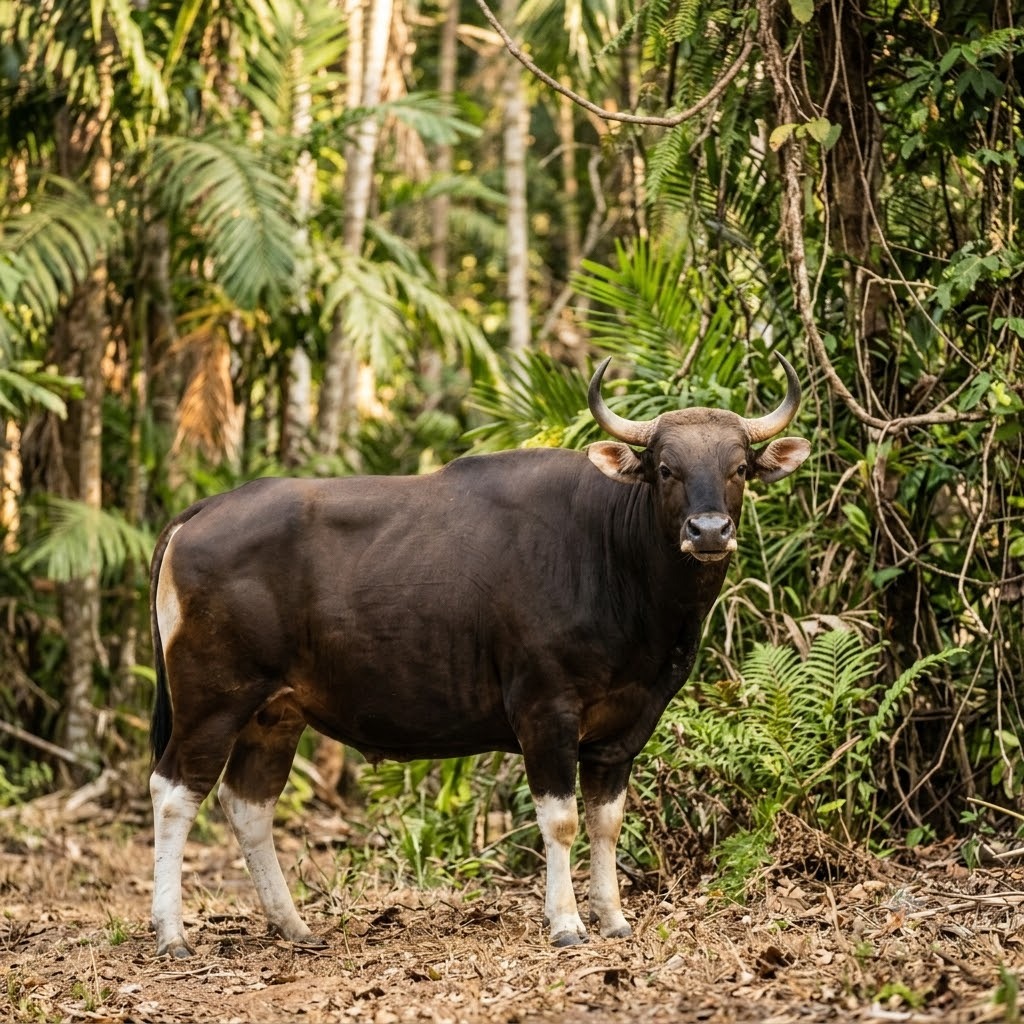
Bulls are dark chestnut to black with white stockings, a white rump patch, and short forward-curving horns; cows and young are tan. The white legs and rump are the banteng's signature.
Range & Habitat
In Australia they occupy the monsoon forests, floodplain margins and open woodland of the Cobourg Peninsula in Arnhem Land, tied to water and shade.
Behavior & Sign
Banteng are wary and forest-loving, moving in small herds and old bulls alone, quick to melt into cover. Sign includes ox-like tracks, dung and trails through the timber.
Hunting Seasons & Timing
Hunted during the dry season, roughly June to October, when access to the remote peninsula is possible and animals concentrate near water.
Hunting Methods
Spot-and-stalk and tracking on foot through forest and floodplain edge, guided by outfitters holding access to the limited hunting area.
Gear & Optics
A stout rifle in .375 H&H or larger with premium bullets suits a heavy, tough bovine in close cover. Bring tropical gear, insect protection and good boots.
Shot Placement & Field Care
Place the shot on the heart-lung area behind the shoulder and be ready to follow up. Recovery in remote country is a logistical effort handled with the outfitter.
Meat & Eating Quality
Banteng is lean, mild beef-like meat, genuinely good eating and usually used in camp.
Common Mistakes
Underestimating the remoteness and cost, undergunning, and rushing a once-in-a-lifetime shot.
Regulations & Conservation
Access is tightly limited and hunted only through permitted outfitters on Aboriginal land; the population is managed as a conservation and cultural asset. Confirm all permissions and import rules. This is a reading guide, not legal advice.
FAQ
Why is it special? It is a rare, free-range wild ox available almost nowhere else to hunters.
How do you hunt one? Only through a permitted Arnhem Land outfitter.