Barasingha
The barasingha, or swamp deer, is a South Asian deer listed as endangered under U.S. federal law and kept in the United States in captive herds, including on Texas ranches.
Last reviewed: November 2026
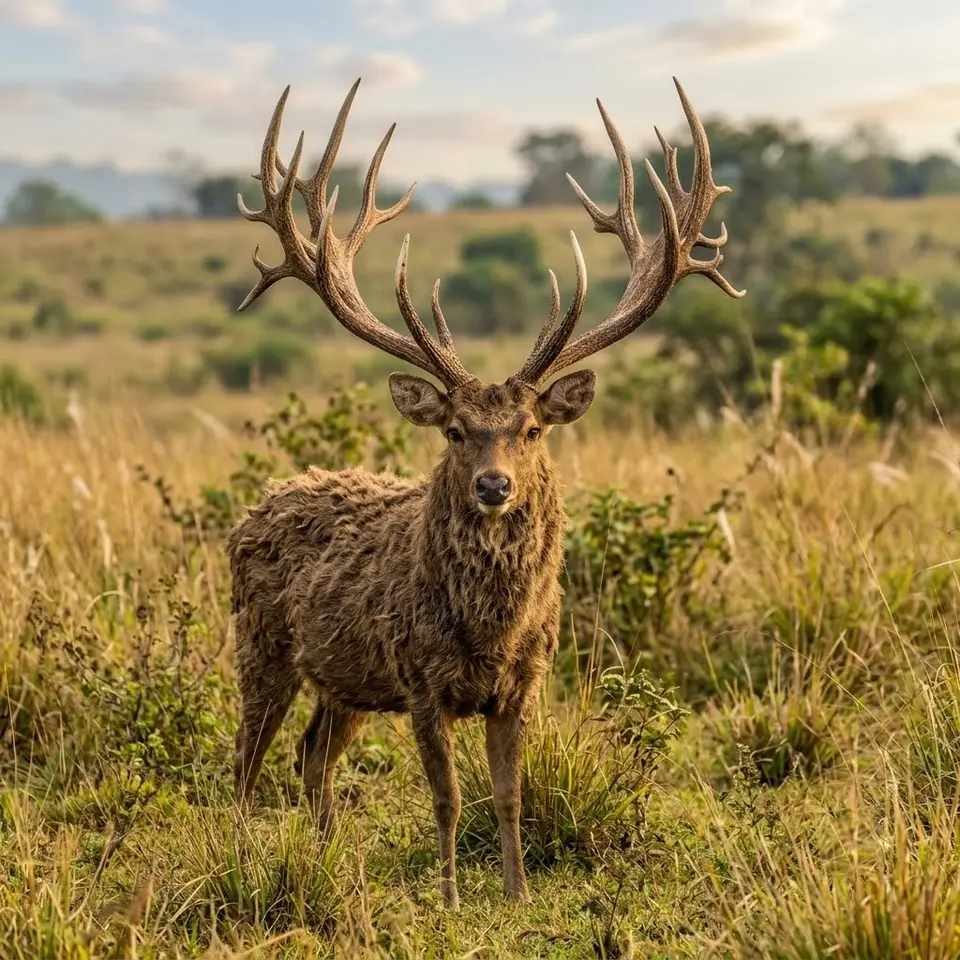 AI illustration
Overview
The barasingha, or swamp deer, is a South Asian deer listed as endangered under U.S. federal law and kept in the United States in captive herds, including on Texas ranches. In the wild, the Animal Diversity Web (ADW) places it in central and northern India and in southern Nepal. The federal list of endangered and threatened wildlife lists it as Endangered wherever found, under the name swamp deer, Cervus duvauceli (50 CFR 17.11), and U.S. Fish and Wildlife Service notices in the Federal Register show Texas ranches applying to register captive-bred barasingha (83 FR 63668; 86 FR 29277).
A barasingha hunt is therefore possible only where it is legal under the federal rules for endangered wildlife (50 CFR 17.21); the FAQ and the regulations note below explain those rules. The name barasingha means "twelve-tined," after the many points on a stag's antlers (ADW).
Identification & Appearance
Adult barasingha stand 119 to 124 cm at the shoulder and weigh about 172 to 181 kg, according to the Animal Diversity Web, which also notes that males are larger than females.
ADW describes a chestnut-brown coat, lighter on the sides and belly, that turns a dull grayish brown in winter; adult males are darker than females, and fawns are born spotted (ADW). A fully adult stag carries 10 to 15 tines, and some have been found with up to 20 (ADW).
Range & Habitat
In the wild, the barasingha lives in central and northern India and in southern Nepal, according to the Animal Diversity Web. ADW lists two subspecies: one in Madhya Pradesh, on grassy floodplains, and one in Uttar Pradesh and southern Nepal, in swampland and forest from dry to evergreen, with both found near water (ADW).
In the United States the animals live in captive herds; Federal Register notices name ranches in Texas among the applicants for federal captive-breeding registrations (83 FR 63668; 86 FR 29277).
Behavior & Sign
Barasingha graze mostly in the morning and evening and rest through the hot afternoon, and they live in herds that average 10 to 20 animals, usually of similar sex and age (ADW). ADW adds that males switch herds more readily than females.
In the rut, which ADW dates from October to February in the native range, stags make muddy wallows and roll in them to carry their scent, and they call with bugles and barks (ADW). When barasingha hear an alarm call, from their own kind or from other animals, they hold the neck up, cock the ears and face the threat, and the rest of the herd takes up the same alert posture (ADW).
Hunting Seasons & Timing
In the United States a barasingha hunt falls under the federal rules for endangered wildlife in 50 CFR 17.21. Those rules make taking endangered wildlife inside the United States unlawful except as they allow, for example under a permit or a captive-bred wildlife registration (50 CFR 17.21), so whether and when a ranch can offer a hunt depends, among other rules, on the federal authorization it holds.
Federal Register notices show Texas ranches applying for permits to cull excess barasingha from their captive herds, which the notices describe as a way to enhance the species' propagation and survival (86 FR 29277; 85 FR 46699), and the U.S. Fish and Wildlife Service states that a captive-bred wildlife registration is valid for five years (USFWS). For the time of day, ADW reports that the deer graze mostly in the morning and evening (ADW).
Hunting Methods
For deer in general, the Missouri Department of Conservation calls a deer's sense of smell its main defense and advises setting up downwind of where you expect deer to approach. For barasingha, ADW adds that herds graze mostly in the morning and evening and that an alarm from one animal puts the rest on alert (ADW), so a stalk or a stand over a feeding area has to account for every animal in the herd, not just the stag.
Where to Find Them - Reading the Terrain
In the native range, ADW ties the species to swamps, grassy floodplains and forest near water (ADW), and in the hot season the deer drink at least twice a day, once soon after first light and a second time in the late afternoon (ADW). On a ranch, ask where the herd feeds and drinks, and watch those places in the morning and evening, when ADW says most grazing happens.
Gear & Optics Needed
The Missouri Department of Conservation notes that a scope gathers light, which helps shot placement in the low light of early morning and late evening. For the field-dressing kit, Penn State Extension lists a sharp knife and a small hatchet with a whetstone or steel, rope or cord, rubber bands, paper towels or clean cloths, sealable bags, a cooler packed with ice or snow, disposable gloves and clean drinking water. Because barasingha graze mostly in the morning and evening (ADW), plan your optics and your shot for low light.
Shot Placement & Field-Dressing
For deer, the Missouri Department of Conservation names the heart-lung area as the only shot to take with a bow and a good choice with a rifle. Missouri's hunter-safety rules add: identify the target and what is beyond it, and never shoot at an animal standing on the horizon with no safe backstop (MDC); in a herd, the deer behind the one you aim at are part of what is beyond it.
USDA's Food Safety and Inspection Service says to field-dress game right after the shot, chill the meat as soon as possible and keep it below 40°F (4°C, computed) until it is cooked or frozen (FSIS). Penn State Extension adds: wear disposable gloves, avoid cutting the paunch and intestines, prop the cavity open or hang the carcass so air can move, and keep it out of direct sunlight.
Meat & Eating Quality
USDA's Food Safety and Inspection Service points out that game shot by hunters is not inspected by federal or state officials and may carry parasites such as Trichinella and Toxoplasma (FSIS). For cooking, its roasting chart lists a minimum internal temperature of 160°F (71°C, computed) for venison roasts (FSIS). We do not give food-safety advice; the USDA FSIS page linked here is the official guide.
Penn State Extension advises against eating meat from a carcass whose organs smell offensive or show a greenish discharge, black blood or clotted blood in the muscle (Penn State Extension). None of the sources used here rates the taste of barasingha meat.
What Ruins the Hunt
An alarm from one deer puts the whole herd on alert: ADW describes alerted barasingha raising their tails, stamping their hooves and calling back and forth until they are sure the danger has passed (ADW). For deer in general, the Missouri Department of Conservation advises against hunting a stand when the wind is against you, however busy it is with deer (MDC).
A shot with no safe backstop, or with other deer behind the target, breaks Missouri's hunter-safety rule to know what is beyond the target (MDC), and a carcass left warm in the sun works against the USDA advice to chill game as soon as possible (FSIS).
Regulations & Conservation Note
The federal list of endangered and threatened wildlife names the swamp deer (Cervus duvauceli) with status E, Endangered, wherever found, listed in 35 FR 8491 on 2 June 1970 (50 CFR 17.11), and a 2018 Fish and Wildlife Service notice spells out that the barasingha (Rucervus duvaucelii) is the species listed there as swamp deer (83 FR 63668).
Under the same federal rules, taking endangered wildlife inside the United States is unlawful; the exceptions include permits under 50 CFR 17.22 and the captive-bred wildlife rules, under which a person must first register with the U.S. Fish and Wildlife Service, and the Service publishes each application in the Federal Register (50 CFR 17.21). ADW names habitat degradation, predation and hunting as the reasons for the species' low numbers in the wild (ADW).
Ask the ranch which federal authorization covers the hunt and confirm it with the U.S. Fish and Wildlife Service. This is not legal advice: seasons, limits, legal methods and tags are set by your state wildlife agency - see the regulations hub. For this species, the federal rules for endangered wildlife apply as well (50 CFR 17.21).
Best Suited For
Good fit if:
- you can confirm before booking which federal authorization covers the hunt, since taking endangered wildlife is unlawful except as 50 CFR 17.21 allows;
- you are ready to pick out one stag in a herd that averages 10 to 20 animals (ADW);
- you can field-dress and chill a deer of about 172 to 181 kg (ADW) quickly, as USDA FSIS advises for game.
Think twice if:
- you would rather not hunt an animal on the federal endangered list (50 CFR 17.11);
- you cannot cool a large carcass quickly in warm weather, which works against the USDA advice to chill game as soon as possible (FSIS).
FAQ
Can I hunt barasingha in Texas or elsewhere in the US? Only where it is legal under the federal rules for endangered wildlife. The federal list names the swamp deer (Cervus duvauceli), which a 2018 Fish and Wildlife Service notice identifies as the barasingha, and lists it as Endangered wherever found (50 CFR 17.11; 83 FR 63668). Taking endangered wildlife inside the United States is unlawful except as the rules allow, for example under a permit or a captive-bred wildlife registration (50 CFR 17.21), and Federal Register notices show a Texas ranch applying for both (86 FR 29277). We do not give legal advice: before booking, ask the ranch which federal authorization covers the hunt and check with the U.S. Fish and Wildlife Service.
Why is it called "twelve-tined"? The name barasingha means "twelve-tined," after the many points on a mature stag's antlers; ADW gives 10 to 15 tines for a fully adult stag and up to 20 in some (ADW).
What habitat do barasingha prefer? In the wild, ADW describes grassy floodplains for one subspecies and swampland and forest from dry to evergreen for the other, with both found near water (ADW). In the United States they live in captive herds, including on Texas ranches (83 FR 63668; 86 FR 29277).
Is barasingha meat good to eat? None of the sources used here rates the taste of barasingha meat. For game in general, USDA FSIS says to chill the meat as soon as possible and lists a minimum internal temperature of 160°F (71°C, computed) for venison roasts (FSIS). We do not give food-safety advice; the USDA FSIS page linked here is the official guide.
How should I approach a barasingha hunt? Plan around the herd: ADW reports that barasingha graze mostly in the morning and evening and that an alarm from one deer alerts the others (ADW), and for deer in general the Missouri Department of Conservation advises setting up downwind of where you expect deer to approach (MDC).
Sources
- Animal Diversity Web: Rucervus duvaucelii (barasingha) - account by A. Ferraino (2007), read 14 November 2026: size, weight, coat, antlers, range, habitat, behavior, rut, causes of decline.
- eCFR: 50 CFR 17.11, Endangered and threatened wildlife - text up to date as of 12 November 2026, read 14 November 2026: swamp deer (Cervus duvauceli), status E, wherever found, 35 FR 8491.
- eCFR: 50 CFR 17.21, Prohibitions - read 14 November 2026: take of endangered wildlife, captive-bred wildlife registration.
- Federal Register, 83 FR 63668 (11 December 2018) - U.S. Fish and Wildlife Service notice of permit applications: barasingha listed as swamp deer, registrations in Texas.
- Federal Register, 86 FR 29277 (1 June 2021) - registration and culling permit applications at a Texas ranch.
- Federal Register, 85 FR 46699 (3 August 2020) - culling permit application at a Texas ranch.
- U.S. Fish and Wildlife Service: 3-200-41 Captive-Bred Wildlife Registration - read 14 November 2026.
- Missouri Department of Conservation: Deer Hunting: Getting Started (2013) - shot placement, scent and wind, scopes.
- Missouri Department of Conservation: Hunter Safety (2020) - the target and what is beyond it, backstop.
- Penn State Extension: Proper Care and Handling of Venison from Field to Table - field-dressing kit and steps.
- USDA FSIS: Roasting Those "Other" Holiday Meats - handling game, venison roast temperature (page updated 5 December 2024).
Field gear for big game
Links go to Amazon or a partner store (such as OpticsPlanet) and may earn us a commission at no extra cost to you. As an Amazon Associate we earn from qualifying purchases. We link gear types, not sponsors' picks: you choose the exact product.