How to Glass for Game
Glassing means finding animals with optics from one spot. Picking a vantage point, sun and wind, a tripod, searching in a grid and looking for pieces of animals, following the Mule Deer Foundation and the Alaska Bowhunter Safety Course.
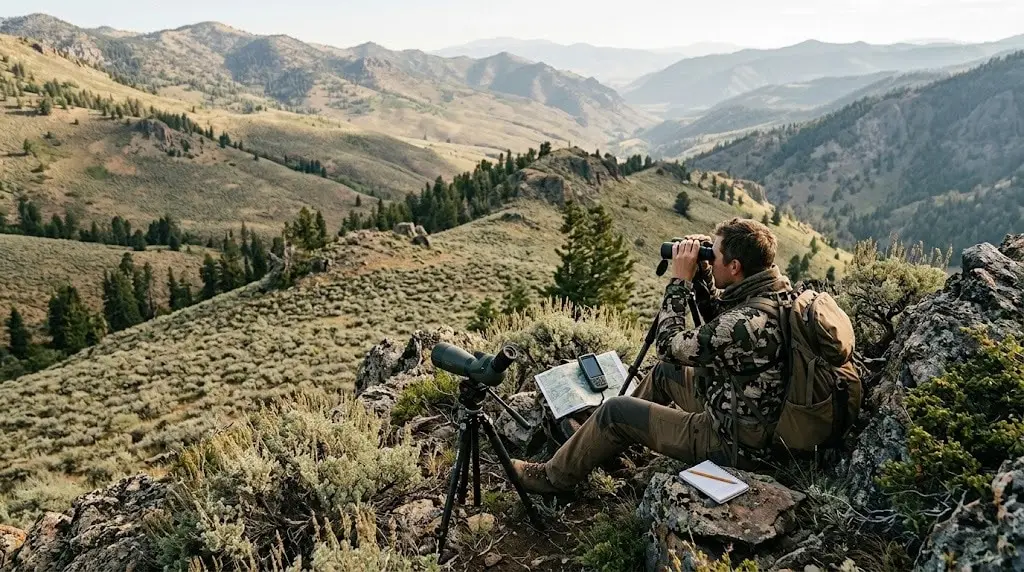
The Alaska Bowhunter Safety Course defines glassing as sitting for a long time at vantage points and spotting game from afar with binoculars or spotting scopes, then stalking it. A Mule Deer Foundation guide to glassing calls it a discipline that rewards patience, attention to detail and a methodical approach. This guide follows both; the foundation’s tips are an experienced hunter’s method, not rules.
Why sit and look
The Mule Deer Foundation notes that in wide, broken western country, success often comes down to what you can see, and that seasoned mule deer hunters spend more time behind their optics than behind the trigger. The Alaska course adds that glassing lets you observe an area quietly without disturbing wildlife, and that early morning and late afternoon are prime times to spot game.
Picking a place to glass from
- See the most with the least movement: knobs, ridgelines or opposite slopes that let you look into basins, across draws and into bedding cover (Mule Deer Foundation).
- Don’t skyline yourself against the horizon.
- Sun at your back, wind in your favour: good light helps you pick apart shadows, and staying undetected keeps deer behaving naturally.
Getting steady
The foundation suggests using a tripod whenever possible: it steadies the image, reduces fatigue and lets you glass longer, while hand-holding often leads to missed detail. Start with binoculars for wide scanning, then switch to a spotting scope when you find something worth a closer look. See our guides to hunting binoculars and spotting scopes.
Searching in a grid
Break the landscape into sections and grid it with your optics, moving slowly and letting your eyes settle into each pocket of cover before moving on. The foundation’s writer glasses bottom to top and right to left, the opposite of reading, because the unfamiliar motion keeps him concentrating.
What you are actually looking for
- Pieces, not whole animals: an ear flick, the curve of an antler, the horizontal line of a back in vertical terrain (Mule Deer Foundation).
- Bedding cover: mule deer spend much of the day bedded, often on north-facing slopes, in shaded pockets, broken rock, and the edges of timber or brush.
- Edges and shadows: where cover meets open ground, and anything out of place, such as a patch of colour, a line that doesn’t fit the terrain, or a small movement.
Stay longer than you think
A basin that looks empty at first light can come alive minutes or hours later, as bucks stand to stretch, change beds or feed briefly (Mule Deer Foundation). Commit to the session.
After you find one
Plan your approach before you move: the Alaska course says stalks are usually most effective from downwind, moving on a diagonal rather than straight at the animal. Our spot-and-stalk guide covers the stalk.
Sources
- Mule Deer Foundation, Glassing techniques for western mule deer. Read 28 October 2026.
- Alaska Bowhunter Safety Course (bowhunter-ed.com), Still hunting, stalking, and glassing and Scout the hunting area. Read 28 October 2026.
Recommended Gear on Amazon
- Binocular tripod adapter - browse current options and reviews on Amazon.
- Lightweight hunting tripod - browse current options and reviews on Amazon.
- Foam sit pad - browse current options and reviews on Amazon.
As an Amazon Associate, we earn from qualifying purchases - at no extra cost to you. This helps us keep producing free, in-depth guides.