Best Night Vision Binoculars
Three night vision binoculars compared from their makers' specs (a digital day-and-night unit, a thermal-plus-digital hybrid and a Gen 2+ tube), digital vs. green and white phosphor, infrared illuminators, and the law to check first.
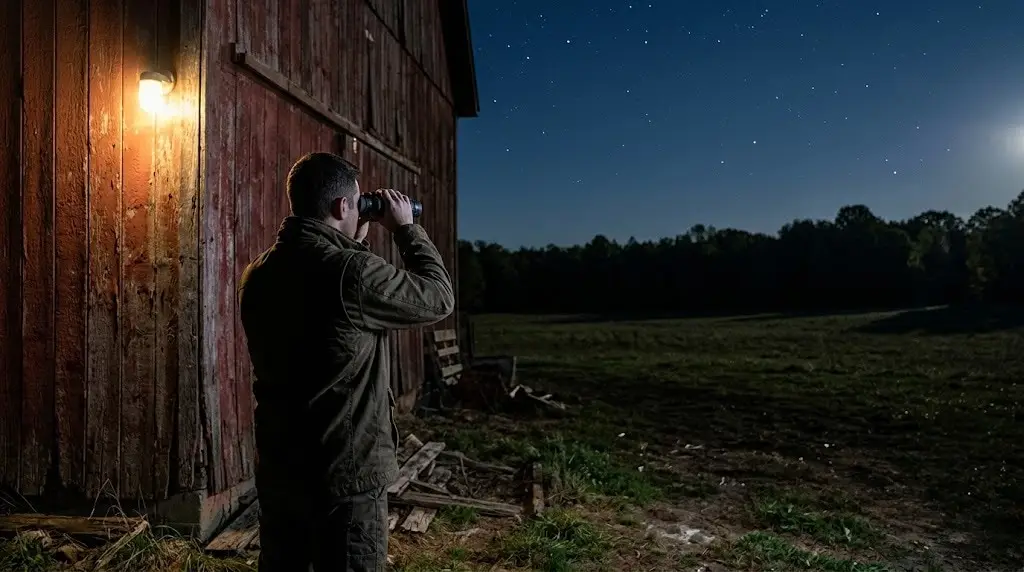
For most hunters and wildlife watchers, the practical night vision binocular is a digital day-and-night unit: it works in daylight as well as at night, records video, and lights up full darkness with a built-in infrared illuminator. A unit built on an image-intensifier tube, such as a Gen 2+ model, is the other kind; it amplifies the faint light already there, and its tube has to be protected from bright light. Before you buy either, check your state’s rules on using night vision for hunting.
Night Vision Binoculars Compared
| Model | Type | From the maker | Links |
|---|---|---|---|
| ATN BinoX 4K 4-16x | Digital day and night binocular | 4K sensor (3864 x 2218); 4-16x with a 40 mm objective; built-in IR illuminator; laser rangefinder, 5-1,000 yards or meters; records 1080p video; Wi-Fi and Bluetooth; battery life 15+ hours; 2.5 lb; weather resistant; works from -20 to 120 °F | See on Amazon · Maker’s page |
| HIKMICRO Habrok 4K 2.0 | Thermal plus digital night vision binocular | A thermal channel (a 384 x 288 shutterless sensor in the HH35L 2.0) and a 4K digital channel for day and night, with IR; a dedicated switch toggles between the two; rear focus wheel for one-handed use | See on Amazon · Maker’s page |
| AGM FoxBat-5 | Gen 2+ image-intensifier bi-ocular | One Gen 2+ tube with a beam splitter feeding two eyepieces; green or white phosphor; runs on two AA batteries for up to 80 hours; tripod mount; bright-light shut-off to protect the tube | See on Amazon · Maker’s page |
How we put this together. Three binoculars, one of each kind on sale (digital, thermal plus digital, and image-intensifier), compared on what each maker states on its own product page, checked on 26 October 2026. We have not used them side by side, and image quality in the dark is not something a spec sheet can show. Where a maker’s spec table did not load for us, we give only what its product description states. Bushnell’s night vision is not in this comparison, and Nightfox is missing because its website is no longer online. There are no prices here: the Amazon link searches for the exact model, and we may earn a commission if you buy through it.
The AGM is a bi-ocular, AGM’s own word for it: one tube split to two eyepieces, so both eyes see the same image, without the depth of two separate tubes. Of the three, only ATN’s page gave us a full spec table, rangefinder and 4-16x zoom included. The HIKMICRO is the one to look at if you want thermal and night vision in one device; our thermal and night vision guide explains what each does better. If you only need one eye, SIONYX sells the Aurora PRO as a digital night vision monocular with full-color night vision and video recording (SIONYX).
Digital vs. Image-Intensifier Night Vision
An image-intensifier device amplifies the little light there is; a digital one combines a camera and a display instead. Wikipedia’s article on night vision devices notes that digital units can offer quality equal to a first-generation tube at a lower cost (Wikipedia); Gen 2, introduced in the 1970s, added a micro-channel plate that gave a much brighter image on moonless nights. In practice the choice comes down to this:
- Digital units work in daylight too, record video, and lean on an infrared illuminator in full darkness. The ATN’s sensor and IR do this job.
- Image-intensifier units like the AGM run for a long time on ordinary batteries, but the tube must be protected from bright light, which is why AGM fits an automatic shut-off.
Green or White Phosphor
On a tube-based unit, the phosphor screen sets the color of the image. Night vision images are typically green, as Wikipedia explains, because green was considered the easiest color to look at for long periods in the dark. White phosphor shows the scene in black and white instead; AGM sells the FoxBat-5 with either. A digital unit has no phosphor at all: it shows the image on a display.
Infrared Illuminators and Total Darkness
Night vision devices are either passive, relying only on the light already there, or active, using an infrared illuminator, as Wikipedia puts it. The ATN has one built in, and HIKMICRO’s digital channel uses IR too.
The Law Comes First
Night hunting and the use of night vision for hunting are set state by state. An older summary of state rules, from 2010-2011 and cited by Wikipedia, found night vision prohibited for hunting in 13 states, restricted in 17 (for example to certain non-game species or dates) and unrestricted in 20; rules change, so read your state wildlife agency’s current regulations before you hunt with one. Watching wildlife or scouting is a different matter from hunting with the device, but check that too. Export is restricted as well: ATN states that its BinoX 4K falls under US export control laws, so a buyer outside the US may not be able to get one shipped. Our thermal and night vision guide covers what to confirm with your state.
Questions About Night Vision Binoculars
Can night vision binoculars see in total darkness? An image-intensifier unit needs some light to amplify; a device with an infrared illuminator adds its own. The ATN and HIKMICRO in the table both have IR.
Is digital or white phosphor better? They are different technologies. White phosphor is a color option on tube-based units; digital units have no phosphor, work in daylight and record video. Battery life differs too: AGM rates the FoxBat-5 at up to 80 hours on two AAs, and ATN gives 15+ hours for the BinoX 4K.
Are night vision binoculars legal for hunting? It depends on the state and the species. Check your state wildlife agency’s regulations before you take one hunting.
For daytime glass, see our hunting binoculars compared.
Recommended Gear on Amazon
- Rechargeable AA batteries - browse current options and reviews on Amazon.
- Binocular harness - browse current options and reviews on Amazon.
- Lens cleaning kit - browse current options and reviews on Amazon.
As an Amazon Associate, we earn from qualifying purchases - at no extra cost to you. This helps us keep producing free, in-depth guides.