Best Binoculars for Wildlife Viewing
Four binoculars for watching wildlife compared from their makers' specs (field of view, close focus, weight and glass), 8x or 10x, and what to pack for Yellowstone or a safari, where you watch from a distance.
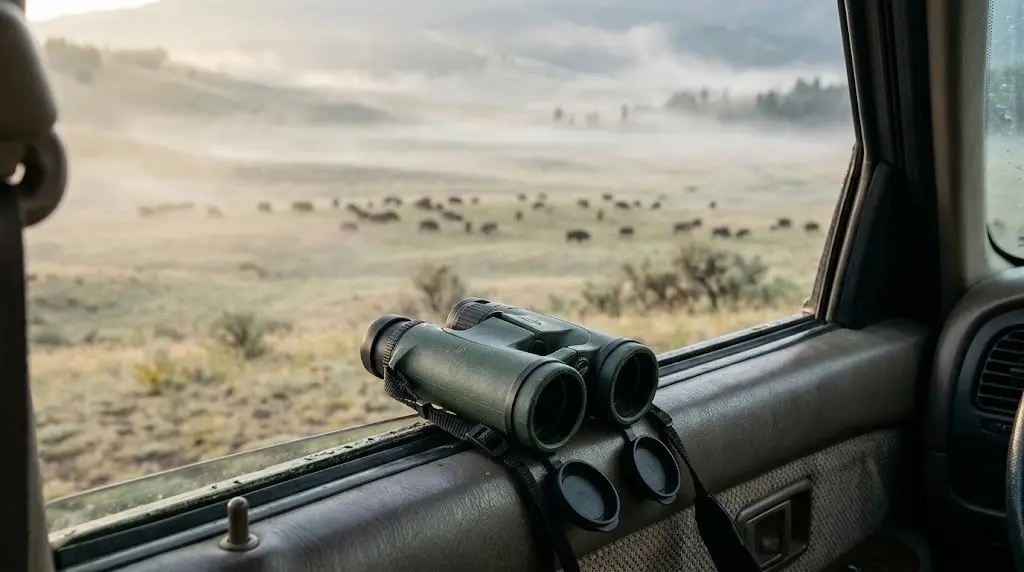
For watching wildlife, an 8x42 binocular is the easiest place to start: its wide field of view makes a moving animal easier to find and follow, which is why Celestron calls its 8x42 a favorite of beginning birders. Choose 10x if you mostly watch from far away. The four below run from an entry-level pair to a premium one, compared from their makers’ own pages.
Wildlife Binoculars Compared
| Binocular | Glass and coatings | Field of view and close focus | Weight | From the maker | Links |
|---|---|---|---|---|---|
| Celestron Nature DX 8x42 | Phase-coated BaK-4 prisms; fully multi-coated | Wide field of view (no figure on the page); close focus 6.5 ft | Not given on the product page | Rubber-armored polycarbonate body; waterproof, fogproof, nitrogen-purged; twist-up eyecups for glasses wearers | See on Amazon · Maker’s page |
| Celestron Nature DX ED 8x42 | ED objective lenses; phase-coated BaK-4 prisms; fully multi-coated | Close focus 6.5 ft | Not given on the product page | The same body as the Nature DX; Celestron says the ED glass cuts color fringing and helps most at dawn and dusk | See on Amazon · Maker’s page |
| Maven C.1 8x42 | ED glass; fully multi-coated; phase correction coating | 341 ft at 1,000 yds (6.5°); close focus 5.9 ft; eye relief 19.5 mm | 24 oz | Polymer frame; waterproof and fogproof; tripod adaptable; lifetime warranty; also sold as 10x42 and 12x42 | See on Amazon · Maker’s page |
| Swarovski NL Pure 10x42 | SWAROVISION field-flattener lenses for sharpness to the edge | 133 m per 1,000 m; about 399 ft per 1,000 yds | 840 g (29.6 oz) | Swarovski describes a field of view without the usual black edge | See on Amazon · Maker’s page |
How we put this together. Four binoculars, three 8x42 and one 10x42, from an entry-level pair to a premium one, compared on what each maker states on its own product page, checked on 26 October 2026. They are different models from the ones in our hunting binoculars comparison, so between the two pages you have nine to look at. We have not compared them side by side, and sharpness, brightness and comfort over hours are things a spec sheet cannot show. Where a page gives no figure, the cell says so. There are no prices here: the Amazon link searches for the exact model, and we may earn a commission if you buy through it.
Maven publishes the fullest spec table of the four, and its own figures show the trade-off between powers: the same C.1 body covers 341 ft at 1,000 yds as an 8x, 314 ft as a 10x and 262 ft as a 12x. The Maven focuses closest of the three with a published figure (5.9 ft), the Celestrons at 6.5 ft, close enough for the plants and insects Celestron mentions. The NL Pure is the premium choice and, at 29.6 oz, the heaviest of the ones with a published weight.
8x or 10x for Wildlife?
Swarovski states the trade-off: higher magnification shows more detail but gives a smaller field of view. An 8x is easier to find an animal with; Celestron says birds are easier to locate and follow in its 8x42’s wide field of view. A 10x brings distant animals closer, which helps when you have to keep far back, as in Yellowstone. Maven and Celestron both sell the same binocular in 8x and 10x, so you can pick the power without changing model.
Binoculars for Yellowstone
Yellowstone’s distance rules are a good reason to bring binoculars. The park asks visitors to stay at least 100 yards (91 m) from bears, wolves and cougars and at least 25 yards (23 m) from all other animals, including bison and elk, and says it is illegal to approach any wildlife closely enough to disturb it (National Park Service). The park’s own advice is that binoculars and telephoto lenses always give a better view than getting closer, and that the safest view is often from inside your car. At 100 yards a 10x is worth considering; from a car window, an 8x is easier to keep on a moving animal.
Binoculars for a Safari
On a safari, as in any trip you fly to, you carry everything you bring, so weigh the binocular against the rest of your kit: the Maven C.1 is 24 oz and the NL Pure 29.6 oz. If you travel through dust, rain or heat, check that your pair is waterproof and fogproof, as the Celestrons and the Maven are described. Bring a harness or a padded strap for long days, and a lens cloth for dust.
Questions About Wildlife Binoculars
What magnification is best for wildlife viewing? For most people, 8x: its wider field of view makes animals easier to find. A 10x helps when animals are far away, as with Yellowstone’s distance rules.
What do the two numbers mean? In 8x42, the 8 is the magnification and 42 the diameter of each objective lens in millimeters; a bigger objective gathers more light.
Do I need ED glass? You can watch wildlife without it. Celestron says its ED lenses cut color fringing and give brighter, sharper images in low light. Both the Nature DX ED and the Maven C.1 have it.
Recommended Gear on Amazon
- Binocular harness - browse current options and reviews on Amazon.
- Lens cleaning kit - browse current options and reviews on Amazon.
- Binocular tripod adapter - browse current options and reviews on Amazon.
As an Amazon Associate, we earn from qualifying purchases - at no extra cost to you. This helps us keep producing free, in-depth guides.