Choosing a Cooler for Game Meat
Why game meat must be cooled fast and kept at 40°F or below, how a cooler fits into field care, sizing for deer and elk, bagging and ice, keeping meat out of the sun, bear-resistant coolers and what IGBC certification means, following Penn State Extension, NMSU and the Interagency Grizzly Bear Committee.
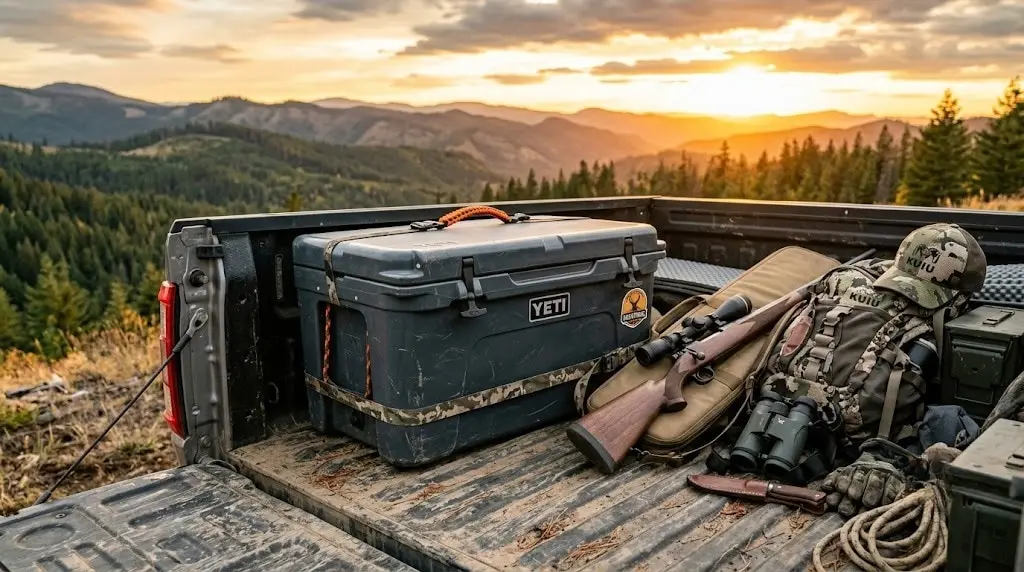
A cooler is the last link between a clean kill and good meat on the table. This guide covers why temperature matters, how a cooler fits into field care, how to size one and what bear-resistant certification means, following Penn State Extension, New Mexico State University (NMSU) and the Interagency Grizzly Bear Committee (IGBC).
Why temperature matters
Bacteria grow most rapidly between 40 °F and 140 °F, a range often called the “temperature danger zone”, in some cases doubling in number every 20 minutes (Penn State). Below 40 °F their growth slows but they are not killed: bacteria that cause foodborne illness grow very slowly or not at all at refrigerator temperatures, while spoilage bacteria, yeasts and molds still grow and spoil meat over time (Penn State). The same page says to use a refrigerator or freezer thermometer to check that the unit stays below 40 °F (Penn State).
| Step | Temperature or time | Source |
|---|---|---|
| Cool the carcass quickly to | 35-40 °F | Penn State |
| Put bags of ice or snow in the body cavity when the air is above | 40 °F | Penn State |
| Hold a carcass you process yourself at | 40 °F or below, for two to three days at most | Penn State |
| Freeze quickly, then store at | 0 °F or below | NMSU |
| Properly wrapped game meat keeps in the freezer for | 9-12 months | Penn State |
Our field care and aging tool covers the steps in more detail.
Using a cooler in field care
- Dress the animal quickly: Penn State says quick field dressing ensures rapid loss of body heat, prevents surface bacteria from growing and improves the quality of the meat (Penn State). While deer carcasses can be kept intact, elk and moose may need halving or quartering to carry them out of the field and to cool them faster (Penn State).
- Ice in the cavity: if the air is above 40 °F, Penn State suggests chilling the carcass with resealable plastic bags of ice or snow in the body cavity, held in place by tying the cavity shut with string, which also keeps out dirt and insects (Penn State). The same page says to put the heart and liver in a plastic storage bag and store them on ice (Penn State).
- No ice or snow: Penn State says to let air circulate in the cavity and to keep the carcass out of direct sunlight (Penn State).
- Keep it dry: if you wash the cavity with water, Penn State says to dry it quickly to prevent spoilage (Penn State).
- Transport: because of heat from the engine or the sun, Penn State says not to tie a carcass across the hood or roof of a car or truck (Penn State), and not to put a deer in the trunk while it is still warm (Penn State). For fish, it suggests covering the cooler with a blanket to keep the flesh out of direct sunlight (Penn State).
- Small game and birds: Penn State says that skinning small game in the field, wrapping the carcass and placing it in a cooler improves the quality and safety of the meat, and that birds should be kept separate during transport so they cool evenly (Penn State).
- Cross-contamination: Penn State says preventing cross-contamination is important when storing and handling meat (Penn State), and its venison guide says to keep raw meat separated, on trays with a lip, in the refrigerator (Penn State).
Sizing
How much meat you will carry decides the size. Our meat yield calculator estimates boneless meat from NDSU tables, and NMSU’s Circular 508 says venison from a boned animal takes up less space in the cold storage locker or freezer (NMSU). Penn State’s list of equipment to bring for field dressing includes resealable plastic storage bags and a large cooler full of ice or snow (Penn State), so leave room for ice as well as meat.
Bear-resistant coolers (IGBC)
- What certification means: IGBC says a certified product has passed either a live test with captive grizzly bears or a technical evaluation (IGBC). The live tests are run by the Grizzly & Wolf Discovery Center in West Yellowstone, Montana, and the Washington State University Bear Center in Pullman, Washington (IGBC).
- Not bear-proof: IGBC says certification does not guarantee that a product is bear-proof, and a certified product must still be used properly: an unlocked cooler is not considered bear-resistant (IGBC). All certified coolers can be locked with a padlock, a carabiner or nuts and bolts (IGBC).
- How to check: IGBC says the best way to verify certification is to match the number on the product to its list, since not all manufacturers put the IGBC logo on their products (IGBC).
- Land rules: many public land managers use the IGBC list to approve products, but IGBC says certification does not mean a product is approved for use on all public lands (IGBC). A non-certified food storage container must be stored in an approved manner, which on most public lands means a locked, hard-sided vehicle, camper or trailer, hung 10 feet from the ground and 4 feet away from anything climbable, or an approved and working electric fence (IGBC). IGBC advises checking with the land management agency whether a product meets local food storage requirements (IGBC); we do not give legal advice.
At home
NMSU says to keep all air out of packages, double wrap them, and label and date them (NMSU). Penn State says thawed meat should be handled in the same way as fresh meat (Penn State). Our processing guide covers butchering.
How we put this together
We read four pages again on 15 November 2026: Penn State Extension’s guides to venison and to wild game and fish, New Mexico State University’s Circular 508 on processing deer at home, and the Interagency Grizzly Bear Committee’s page on bear-resistant products. Every figure on this page comes from one of them, with the link in the same sentence or table row. We have not tested any cooler, we compare no models and we quote no prices or ice-retention times: those are the makers’ own claims, and they change. The Amazon links below search for a type of product rather than a model we picked.
Sources
- Penn State Extension, Proper Care and Handling of Venison from Field to Table, updated 18 November 2020. Read 15 November 2026.
- Penn State Extension, Proper Field Dressing and Handling of Wild Game and Fish, updated 14 September 2022. Read 15 November 2026.
- New Mexico State University, Processing Your Deer at Home (Circular 508), printed January 1994. Read 15 November 2026.
- Interagency Grizzly Bear Committee, Bear Resistant Products. Read 15 November 2026.
Recommended Gear on Amazon
- Rotomolded cooler - browse current options and reviews on Amazon.
- Elk game bags - browse current options and reviews on Amazon.
- Reusable ice packs - browse current options and reviews on Amazon.
As an Amazon Associate, we earn from qualifying purchases - at no extra cost to you. This helps us keep producing free, in-depth guides.