Spotting Scope
A spotting scope is a high-power telescope on a tripod for judging animals a mile away - indispensable in open country, dead weight in the timber. Know which you hunt.
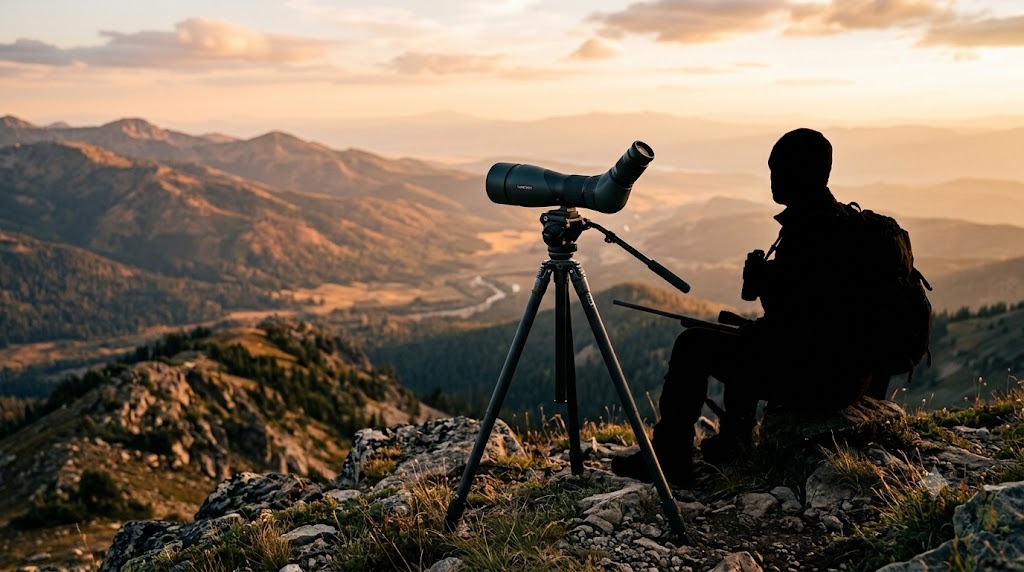
When you hunt country where you can see for miles - western mule deer basins, sheep faces, pronghorn flats - a spotting scope earns its weight by letting you judge an animal's size, sex and legality across a canyon before you commit to a two-hour stalk. It magnifies far beyond binoculars but demands a tripod to be usable. In thick timber or from a treestand, it's the wrong tool entirely.
What it is & when you need it
A compact high-power telescope, tripod-mounted, for detailed long-range observation. You need one only if you hunt genuinely open country and must judge animals at distances where binoculars can't resolve antler detail - otherwise it's weight you'll never justify.
How to read the numbers
'20-60x80' = zoom from 20× to 60×, with an 80mm objective. Big objectives (80-85mm) gather the light high magnification needs but weigh a lot; compact 65mm scopes save pack weight at some low-light cost. Angled bodies suit sharing and steep uphill glassing; straight bodies are quicker for beginners and truck-window use.
What actually matters
Glass quality is everything at high magnification - cheap scopes turn to mush past 30×, exactly when you need them. Prioritise resolution at the TOP of the zoom range, low-light performance, and a genuinely stable tripod (a great scope on a wobbly tripod is useless). Weight decides whether it comes on the mountain or stays home.
Where it fits in your kit
A specialist, open-country optic bought AFTER binoculars and a rangefinder - and only if your hunting demands it. Binoculars find animals; the spotter judges the ones worth stalking. Pair it with a solid tripod and, optionally, a phone adapter for 'digiscoping' photos to study later.
Care & field tips
A stable tripod matters as much as the scope. Glass in the cool, steady air of early morning; midday heat shimmer ('mirage') destroys high-magnification clarity. Back the zoom off to 20-30× when mirage builds. Keep the big objective capped against dust and rain in the pack.
Common mistakes
Buying one for timber or treestand hunting where it's useless deadweight, pairing it with a flimsy tripod, cranking to 60× in midday mirage and seeing nothing, and skimping on glass (cheap high-power spotters are worse than good binoculars). Right country only, good glass, solid tripod.
🧭 This is brand-free buying guidance, not product recommendations - we describe what matters so you can choose for yourself. Optics regulations (thermal, night vision, cellular cameras) vary by area and change often; confirm current rules with your official wildlife agency before buying or hunting. We don't give legal advice.