Red Dot Sight
A red dot is a no-magnification sight showing a glowing aiming dot - fast, both-eyes-open, and ideal for close, moving targets like turkeys, hogs and slug-gun deer in thick cover.
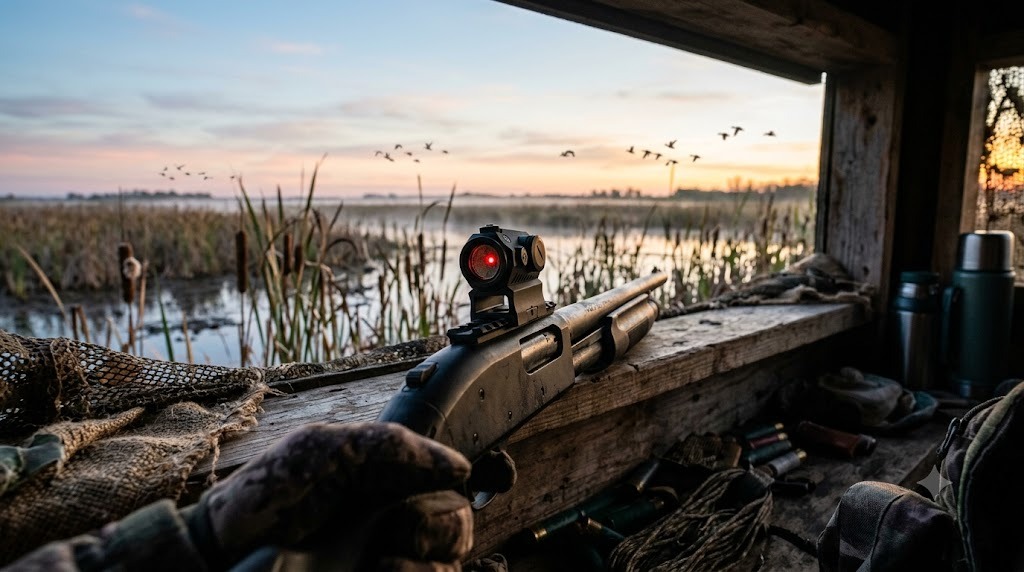
Where a riflescope magnifies for precision at distance, a red dot does the opposite job supremely well: instant target acquisition up close. You keep both eyes open, put the glowing dot on the target, and shoot - no crosshair alignment, no eye-relief window, no magnification wobble. For turkey guns, slug guns, hog rifles and any close, fast, moving-target hunting in thick cover, it's often better than a scope.
What it is & when you need it
A non-magnifying (1×) sight that projects an illuminated dot onto a lens; align dot with target, fire. Ideal for shotguns (turkey, deer slugs), pistol-calibre and close-range rifles, and any hunting inside ~100 yards where speed beats precision.
How to read the numbers
Dot size is in MOA (minute of angle) - roughly the dot's inches of coverage per 100 yards. A 2-3 MOA dot suits precise close rifle work; a 4-6 MOA dot is faster to catch on a moving turkey or hog but covers more of a small target. 'Reflex/open' sights are light and fast; 'tube' sights are tougher and better in rain.
What actually matters
Battery life (good red dots run for years - always-on matters when game appears at dawn), dot clarity and brightness range (bright enough for snow glare, dim enough for dusk), rugged waterproof construction, and a rock-solid mount that holds zero under recoil, especially heavy shotgun loads.
Where it fits in your kit
A specialist close-range sight, not a do-everything optic. Perfect on a dedicated turkey or slug gun, a hog rifle, or as a backup. For open-country big game you still want a magnified scope; some hunters run a red dot with a flip-to-side magnifier as a compromise.
Care & field tips
Leave it powered on (or use auto-on models) so it's ready instantly. Set brightness for the conditions, confirm zero with your actual hunting load, and carry a spare battery. Co-witness with iron sights if the gun has them, as a fail-safe. Keep the emitter lens clean - a smeared dot is a fuzzy dot.
Common mistakes
Using one where you need magnification (past ~100 yards a red dot leaves detail and precision on the table), a dot too large for precise shots or too small for fast ones, letting the battery die (leave it on), and a cheap mount that loses zero under shotgun recoil. Right job, quality mount.
🧭 This is brand-free buying guidance, not product recommendations - we describe what matters so you can choose for yourself. Optics regulations (thermal, night vision, cellular cameras) vary by area and change often; confirm current rules with your official wildlife agency before buying or hunting. We don't give legal advice.