Redbone Coonhound
The Redbone Coonhound is a versatile American treeing hound that trails coon and big game by nose and voice - driven, vocal, and built for the long night trail.
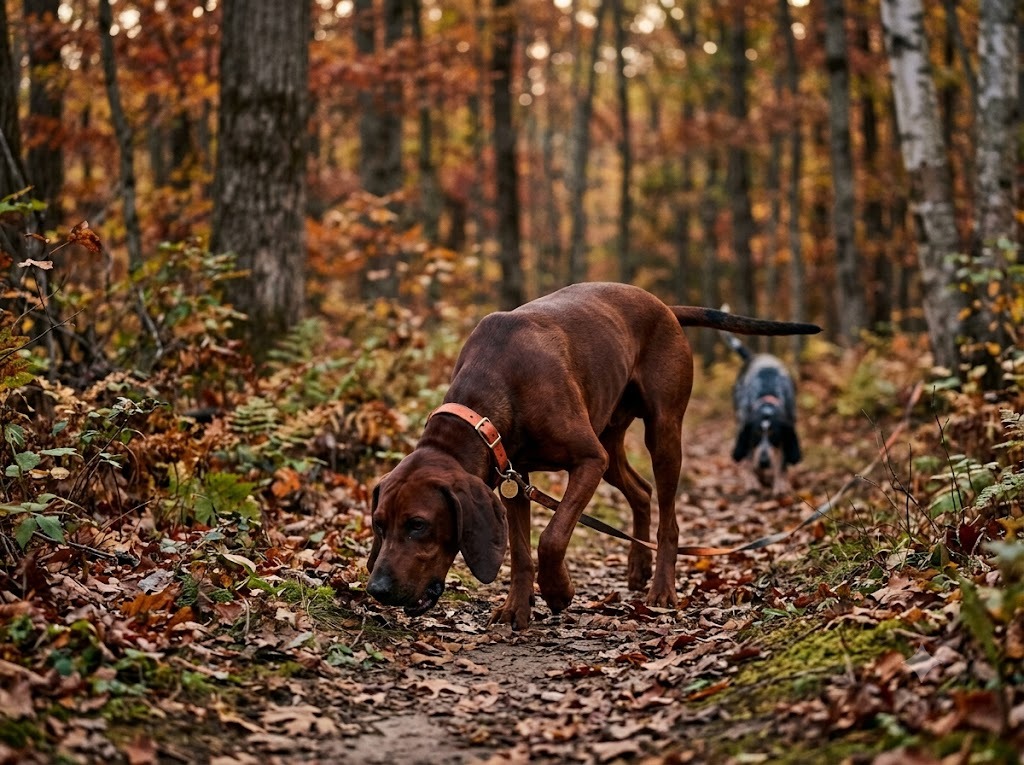
The Redbone Coonhound is a lean, solid-red American treeing hound built for the long trail, hunting by nose and voice across swamp, timber, and mountain. Bred to strike a track, run it hot, and tree its quarry while bawling loud, it doubles as a capable big-game dog.
What it was bred to do
The breed took shape in the 1800s American South from red foxhounds brought by Scottish and Irish settlers, then bred for a clean solid coat and sharper treeing instinct. The main job was night raccoon, but Redbones were also run on bear, cougar, and bobcat, prized for a nose that works both hot and cold tracks over rough country.
In the field
A Redbone casts ahead to strike scent, then opens with a deep bawl that turns choppy as it closes and trees. It ranges wide, works water and steep timber without fuss, and stays treed and vocal until you arrive. A night with one is loud, footwork-heavy, and led by the dog's nose more than your commands.
Temperament and trainability
At home it is even-tempered and affectionate, with a genuine off-switch. In the field it is single-minded, and that independence reads as stubbornness when a track pulls harder than your call. It is a sensitive dog that sours under heavy hands, so most handlers lean on reputable breeders and professional gun-dog trainers.
Best game and conditions
It suits raccoon first, and it is strong on bear, cougar, and bobcat where legal, in warm-to-temperate country from swamp to hardwood ridge. The short coat handles heat and water well but gives little against hard cold. It is not the dog for a hunter who wants close, quiet, biddable work.
Health and honest notes
As a deep-chested, high-drive hound it carries the general considerations common to big active hounds, and its drop ears and hard field use warrant routine attention. The short coat sheds and offers thin protection in cold or brush. For anything about choosing a pup, its health, or its care, rely on reputable breeders and your veterinarian.
What you get
For the right hunter, a tireless, big-nosed partner with a beautiful voice and the grit to tree coon all night or push dangerous game by day - a true woods dog that lives to hunt.
Common mistakes
Giving it too little work, which breeds a bored, noisy, escape-prone dog. Expecting obedience-trial control from an independent trailing hound. And treating its constant baying as a fault rather than the tool it was bred to be.
FAQ
Good for a first-time owner? It can be, but the drive, range, and voice suit someone ready to hunt and train consistently.
Will it live indoors? Yes, it settles well at home given real exercise and a job.
How loud is it? Very - that voice is the point, and you will not train it out of a working hound.
🐕 A field-focused look at this breed as a working partner - not a training manual and not a guide to raising or caring for a dog. Drive, biddability and health vary hugely within any breed. Talk to reputable breeders, professional gun-dog trainers and your own veterinarian before you choose, train or hunt a dog, and keep a working dog's safety and welfare first in heat, cold and water.