Bowfishing Points
Heavy barbed points tied to a line, not broadheads for game - they punch through rough fish and hold them for the retrieve, a different job from any hunting head.
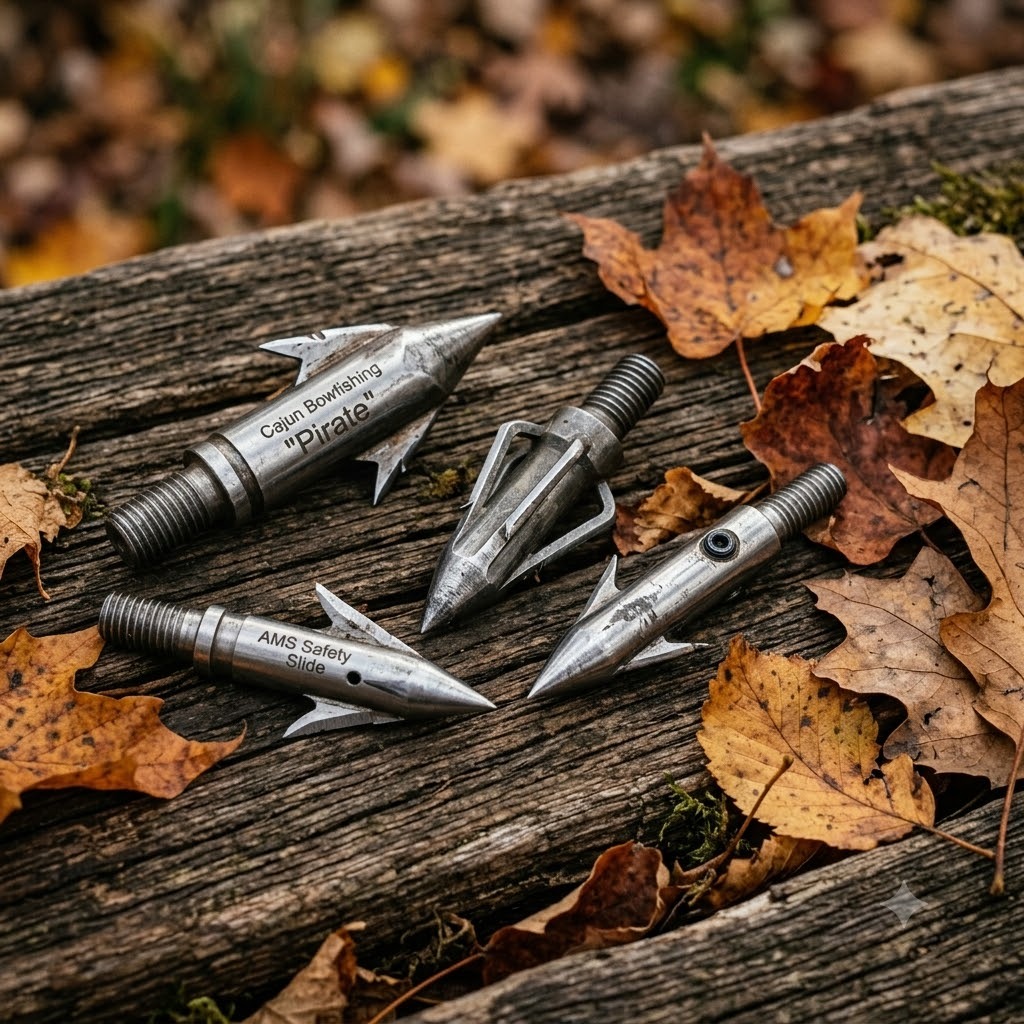
⚠️ A bowfishing arrow is tethered to a line, and a tangled line can snap the arrow back at the shooter. Rig only with an arrow safety slide (or the exact system your arrow and point maker specifies), follow the manufacturer's rigging instructions, and never shoot if the line can catch the bowstring or reel. This page is an overview, not rigging instructions.
Bowfishing points are their own tool, and confusing them with hunting broadheads causes both bad shots and broken gear. Instead of slicing for a clean kill and passing through, a bowfishing point is a heavy, barbed tip on an arrow tethered to a line. It drives through a rough fish, the barbs open to hold, and you haul the fish back on the line. Everything about the design serves penetration in water and retention on the retrieve.
What it is
Solid, heavy points with reversible or fold-back barbs, mounted on fiberglass or hybrid bowfishing arrows rigged to a reel and line. Common styles use screw-off tips or a barb that flips open on penetration and reverses to release, so you can back the fish off the point after landing it. They are legal only for rough/nongame fish where bowfishing is permitted.
How it works
The point's mass and narrow profile drive it through a fish despite water's resistance, and the barbs then catch on the far side so the fish cannot slide off. The attached line lets you fight and retrieve the fish. A reversing barb or removable tip lets you free the fish from the arrow without cutting the whole rig apart.
Strengths
Deep penetration on tough-scaled rough fish, strong holding power so fish do not slip the point during the fight, and quick release designs that speed up de-arrowing between shots. Built for abuse - dragged through mud, rock and gravel - they take punishment that would destroy a hunting broadhead.
Trade-offs
They are heavy and fly only at very short range, so bowfishing is a close-quarters game. Barbs must be maintained and can bend or dull on hard bottoms. They serve exactly one purpose - rough fish on a line - and are useless for game. Local regulations tightly define which species and waters are legal, and that check comes before the shot, not after.
Tuning & practice
Rig the point to a proper bowfishing arrow, reel and line - with an arrow safety slide, per the maker's instructions - rather than a target or hunting setup. Practice the steep aim-low correction for refraction, since a fish is never where it appears. Keep barbs sound and the tip tight, learn the reverse-barb release for your specific point, and confirm the species and water are legal for bowfishing where you are.
Common mistakes
Treating a bowfishing point like a hunting broadhead (or vice versa), aiming straight at the visible fish instead of low for refraction, shooting at long range where the heavy point falls off fast, and ignoring the strict species and water rules that govern where bowfishing is allowed at all.
🧭 Brand-free guidance, not product recommendations - we explain what matters so you can choose for yourself. Always verify your setup's flight with the actual hunting heads before the season, and follow your state's equipment regulations (minimum draw weights, broadhead rules and lighted-nock legality vary).