Surf Scoter
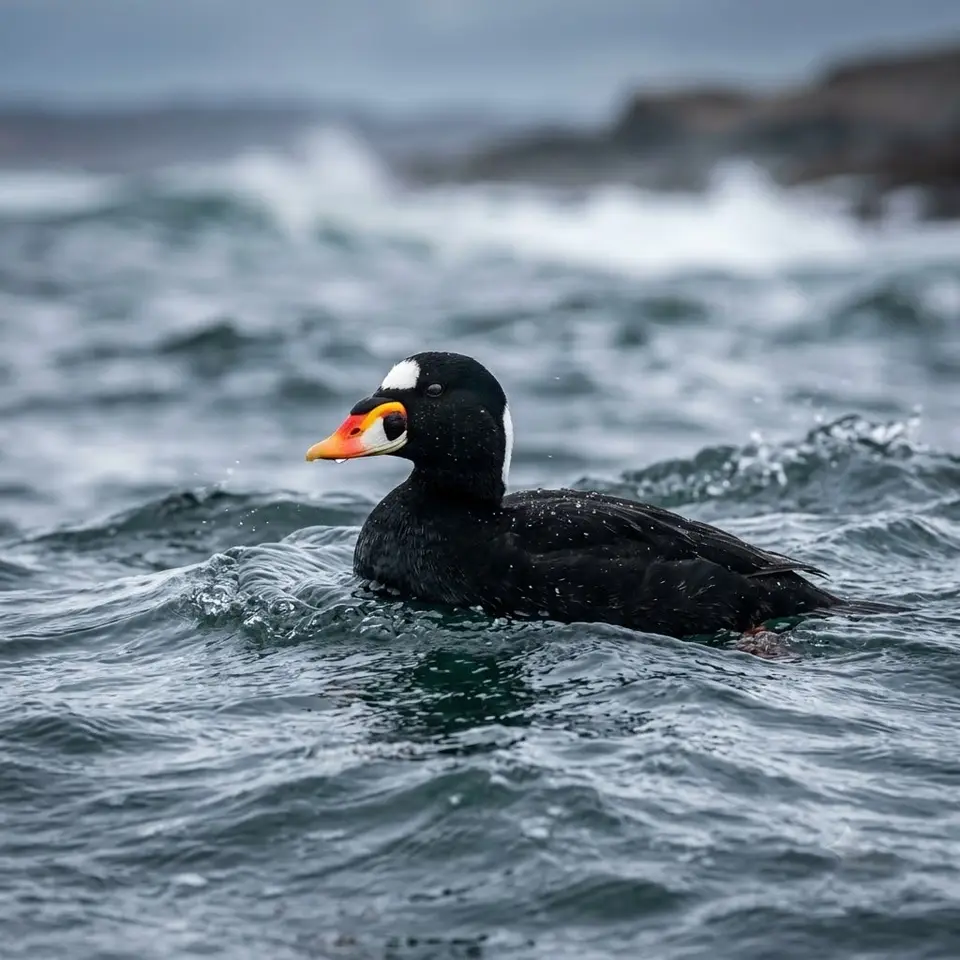
The surf scoter is the scoter with white on its head: the drake carries one white patch on the forehead and another on the nape, and no other North American scoter does.
Last reviewed: October 2026
 AI illustration
Overview
The surf scoter is the scoter with white on its head: the drake carries one white patch on the forehead and another on the nape, and no other North American scoter does. It breeds only in North America, mostly in northern Canada and Alaska, and winters along both the Pacific and Atlantic coasts, where sea-duck hunters meet it over decoys in open water (Wikipedia, "Surf scoter").
Identification & Appearance
Drakes are velvety black apart from the two white head patches, with a swollen bill that looks orange at a distance and is patterned with white, red and yellow. Hens are browner and fairly uniform, with indistinct pale patches on the cheeks, a bulkier, square-based bill and a flatter head profile than other scoter hens. In flight this is the only one of the three scoters with completely dark wings, and Wikipedia's species account gives it as the smallest scoter on average. They fly low and heavy over the swells.
Range & Habitat
Nesting takes place far from salt water, near freshwater lakes in the northern boreal forest. Winter is spent in marine water close to shore; the Pacific coast holds the most birds, with a winter range that runs from the Aleutian Islands of Alaska to Baja California, and the Atlantic coast holds the rest (Wikipedia, "Surf scoter"). In between, the birds gather in bays, inlets and estuaries to molt their flight feathers, and for a few weeks in late summer they cannot fly.
Behavior & Sign
Surf scoters feed on the bottom, taking crustaceans, snails and small bivalves such as mussels, and on the Pacific coast they turn to herring spawn in late winter and spring. Winter flocks run from a few birds to several thousand, and a feeding flock tends to dive together. Away from the breeding grounds they are mostly silent. They raft over mussel and clam beds and trade low along the coast, decoying to sea-duck spreads.
Hunting Seasons & Timing
The season falls in late fall and winter, when the birds are on salt water; they are hunted from layout boats and from points along the shore.
Hunting Methods
Long lines of scoter and eider decoys off points, hunted from anchored layout boats or rock blinds in the surf zone.
Gear & Optics
A 12-gauge with steel shot from #2 to BB, a boat fit for open water and full cold-water safety gear. Whether the hunt happens at all depends on the boat and the weather.
Shot Placement & Field Care
Close shots over the decoys, quick recovery of divers, and prompt breasting are the drill.
Meat & Eating Quality
Like other sea ducks, scoters are strong and fishy; most hunters breast, soak and cook them boldly.
Mistakes That Cost a Shot
Unsafe water, poor concealment, and expecting mild table fare from a shellfish-eating diver.
Regulations & Conservation
Like other sea ducks, surf scoters come under migratory-bird seasons and limits of their own. Confirm the current federal and state regulations, and think safety through, before hunting. We do not give legal advice.
FAQ
Why hunt scoters? Bold-looking drakes, good decoying and classic sea-duck action.
How do I tell it from the other scoters? White patches on the drake's head, and wings that are completely dark in flight.
Table quality? Strong; managed with soaking and seasoning.
Sources
- Wikipedia, "Surf scoter" (read 12 October 2026): size, plumage, range, molt, diet and flocks.
Field gear for waterfowl
Links go to Amazon or a partner store (such as OpticsPlanet) and may earn us a commission at no extra cost to you. As an Amazon Associate we earn from qualifying purchases. We link gear types, not sponsors' picks: you choose the exact product.