Desert Cottontail
The desert cottontail is the common rabbit of the arid Southwest and Great Basin, a staple small-game target across sagebrush, desert and brushland.
🗓️ Last reviewed: July 2026
Overview
The desert cottontail is the common rabbit of the arid Southwest and Great Basin, a staple small-game target across sagebrush, desert and brushland. Abundant and available with a generous season, it is a favorite of Western walk-up and rimfire hunters.
Identification & Appearance
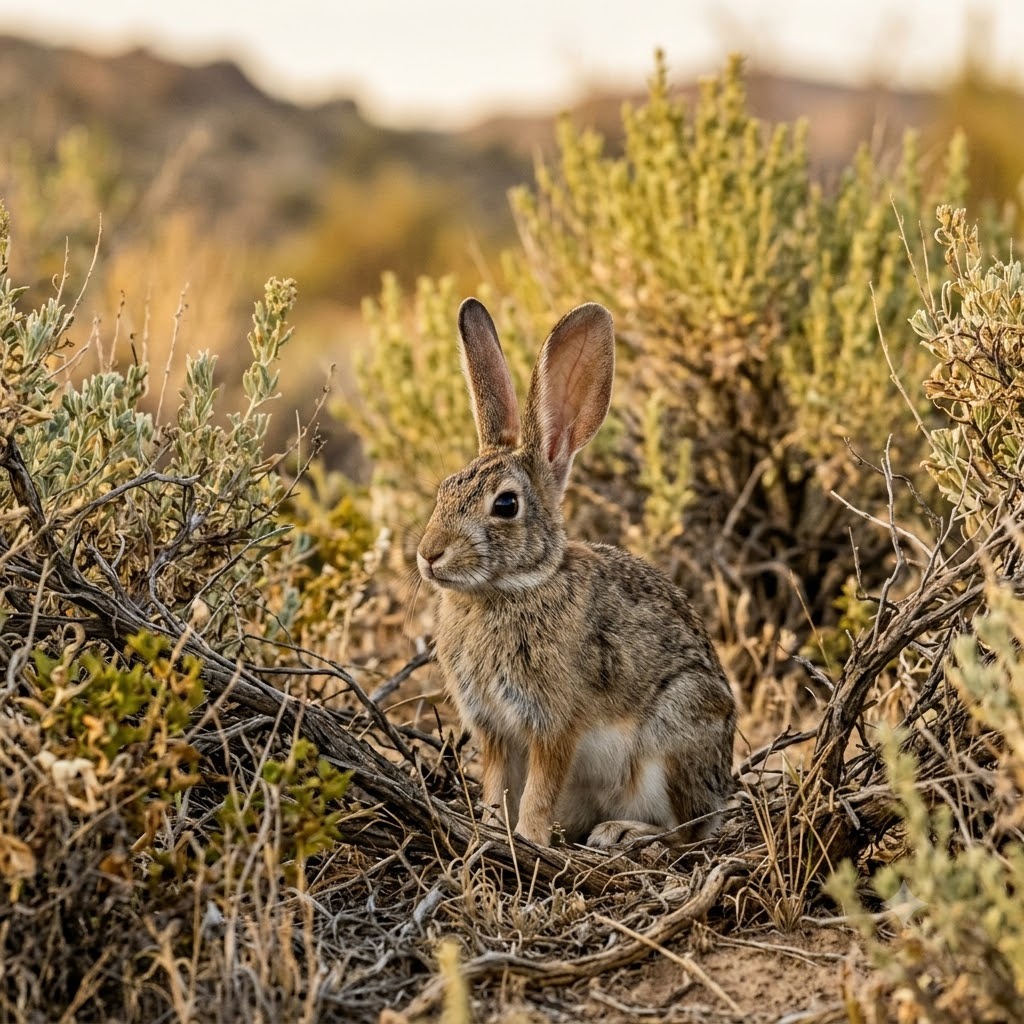
Desert cottontails are pale grayish-brown with large ears, long legs and the classic white cottontail. They are a bit larger-eared and paler than the eastern cottontail, suited to hot open country.
Range & Habitat
They occupy desert scrub, sagebrush, grassland and brushy washes across the arid West and Southwest, sheltering in brush, burrows and rock piles.
Behavior & Sign
Cottontails feed at dawn, dusk and night, freeze or dash for cover when approached, and rarely stray far from a bolt-hole. Sign includes pellets, forms and browsed vegetation.
Hunting Seasons & Timing
Often huntable with long fall-winter seasons and generous limits; cooler weather is best for both hunter and safe handling. Confirm the local season.
Hunting Methods
Walk-up hunting through brush and washes, jump-shooting rabbits from cover, and still-hunting the edges early and late.
Gear & Optics
A .22 rimfire for sitting rabbits or a 20 or 12-gauge with #6 for running shots, plus brush-worthy clothing.
Shot Placement & Field Care
Clean rimfire head or shoulder shots, or leading patterns on runners; field-dress promptly and wear gloves.
Meat & Eating Quality
Desert cottontail is fine eating - mild and tender, best fried or in stews, and always cooked thoroughly.
Common Mistakes
Handling rabbits bare-handed and not cooking the meat through - important for food safety with wild rabbits.
Regulations & Conservation
Managed as small game with generous seasons; as with all wild rabbits, handle with gloves and cook thoroughly. Confirm the local rules. We do not give legal advice.
FAQ
Desert or eastern cottontail? Desert cottontails are paler, bigger-eared and adapted to arid country.
Safe to eat? Yes, handled with gloves and cooked thoroughly.