Asian Water Buffalo
The Asian water buffalo is a massive wild bovine hunted as free-range game in Australia's Northern Territory and on exotic ranches in Texas.
Last reviewed: October 2026
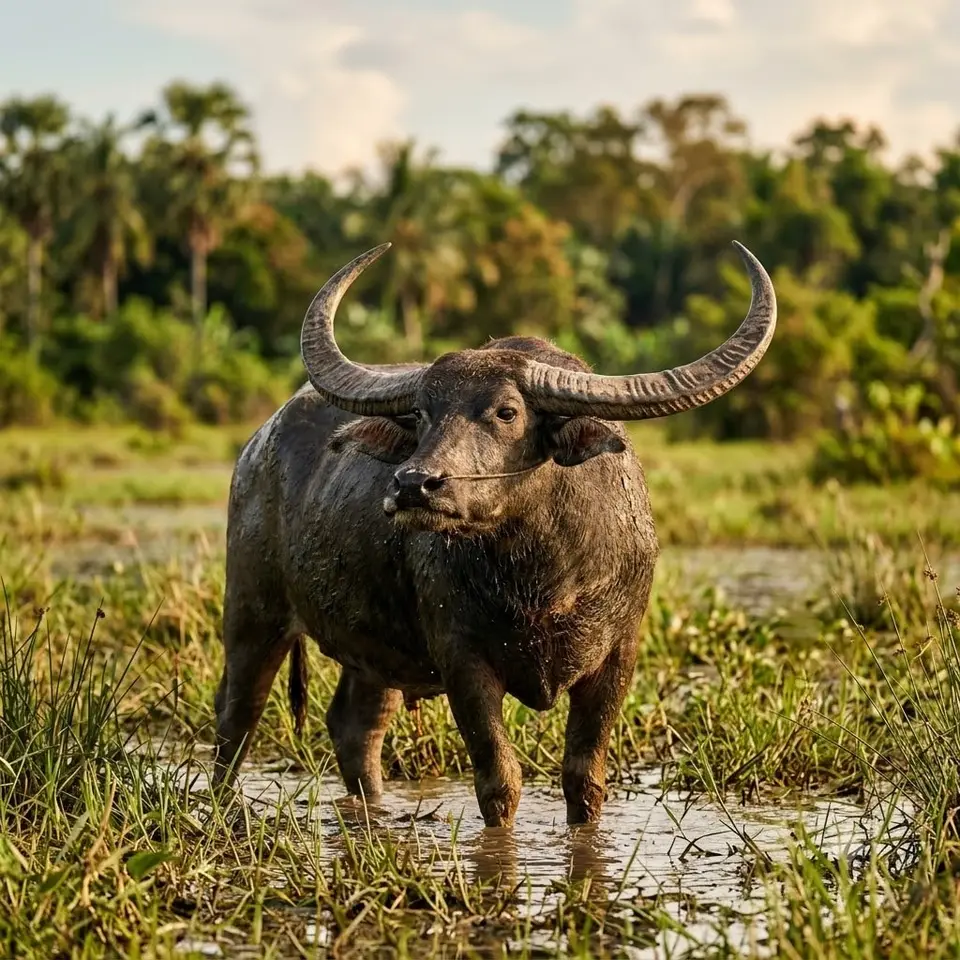 AI illustration
Overview
The Asian water buffalo is a massive wild bovine hunted as free-range game in Australia's Northern Territory and on exotic ranches in Texas. They usually weigh 300-550 kg (660-1,210 lb), animals over 1,000 kg (2,200 lb) have been recorded, and bulls carry enormous sweeping horns, making them one of the largest animals a hunter can pursue on foot.
Identification & Appearance
Water buffalo are slate-gray to black, heavy-bodied, with a low-slung head and long crescent horns that sweep back and up. Bulls are far more massive than cows, with thicker horn bases and a heavier neck and hump.
Range & Habitat
Feral herds live in the tropical floodplains, swamps and paperbark country of northern Australia. Swamp buffalo were brought to the Northern Territory from Timor and nearby islands between 1824 and 1849 and turned loose when the Cobourg Peninsula settlement was abandoned; river buffalo followed from India in the 1880s. After the brucellosis and tuberculosis culls that ended in 1997, numbers recovered to an estimated 200,000 by 2022, and Melville Island holds a steady population of up to 4,000. In the US, ranch animals occupy brush and pasture in Texas and the Gulf states. They are tied to water and mud wallows.
Behavior & Sign
Buffalo are slow and placid at a distance but dangerous when pressed, and old bulls are solitary and wary. They leave deep tracks, churned wallows and obvious trails through swamp grass.
Hunting Seasons & Timing
In Australia buffalo are hunted through the dry season, roughly May to October, when floodplains firm up. On US ranches the season is set by the state's rules and the ranch; cooler months are more comfortable for the work of packing one out.
Step by Step: Planning a Water Buffalo Hunt
1. Choose where. Two very different hunts:
- Northern Territory, Australia: free-range feral buffalo on the floodplains of the Top End, with safari outfits running from Darwin to places such as Melville Island (Wikipedia).
- A US exotic ranch: mainly Texas, under the state's rules and the ranch's own.
2. Sort out the paperwork early. Ask the outfitter or ranch which licences and permits you need; for a trip to Australia, check the rules for bringing a firearm into the country, and for any trophy or meat, the import rules of your own country.
3. Pick the season. In the Northern Territory, the dry season, roughly May to October, when the floodplains firm up; on a ranch, the cooler months make the work easier.
4. Bring enough gun. A stout rifle, .375 H&H or larger with premium bonded or solid bullets, and practice from shooting sticks.
5. Hunt on foot. Glass from the edges, then stalk with the wind in your face; old bulls are often alone and wary.
6. Make the first shot count. Heart-lung area behind the shoulder, then be ready to shoot again at once; a wounded bull is dangerous.
7. Plan the recovery. An animal of 500 kg or more in mud or swamp needs a crew, a vehicle or packframes, saws and knives.
8. Cool the meat fast. Quarter it and get it into shade and onto ice; the tropical heat spoils meat quickly.
Hunting Methods
The method is spot-and-stalk on foot across open floodplain or brush, closing carefully on a mature bull. Shots may be close in cover, so a steady rest and a decisive first hit matter.
Gear & Optics
A stout rifle in .375 H&H or larger with premium bonded or solid bullets is standard; .338 is a practical floor for ranch bulls. Bring good boots for mud, insect protection and a rangefinder for open-country shots.
Shot Placement & Field Care
Place the shot on the heart-lung area behind the shoulder and be ready to follow up. These animals are enormous - plan for a quartering crew, a vehicle or packframe, and prompt cooling of the meat in the heat.
Meat & Eating Quality
Water buffalo is lean and mild, and good eating in roasts, burger and slow braises.
Habits That Spook Game
Underestimating the size and toughness of a bull, undergunning, and having no plan to recover a 1,500-pound animal from a swamp are the usual pitfalls.
Regulations & Conservation
Australian buffalo hunting is managed to control an invasive population; US ranch hunting is regulated by the state and the property. Confirm licensing, transport and import rules before you book. This is a reading guide, not legal advice.
FAQ
Are they dangerous? A wounded or cornered bull absolutely is; treat them with the respect you would give any dangerous game.
Is the meat worth keeping? Yes - lean, mild and excellent, and often the whole point of a management hunt.
Field gear for big game
Links go to Amazon or a partner store (such as OpticsPlanet) and may earn us a commission at no extra cost to you. As an Amazon Associate we earn from qualifying purchases. We link gear types, not sponsors' picks: you choose the exact product.