Cape Buffalo
The Cape buffalo is the most dangerous of Africa's Big Five and the benchmark of dangerous-game hunting.
🗓️ Last reviewed: July 2026
Overview
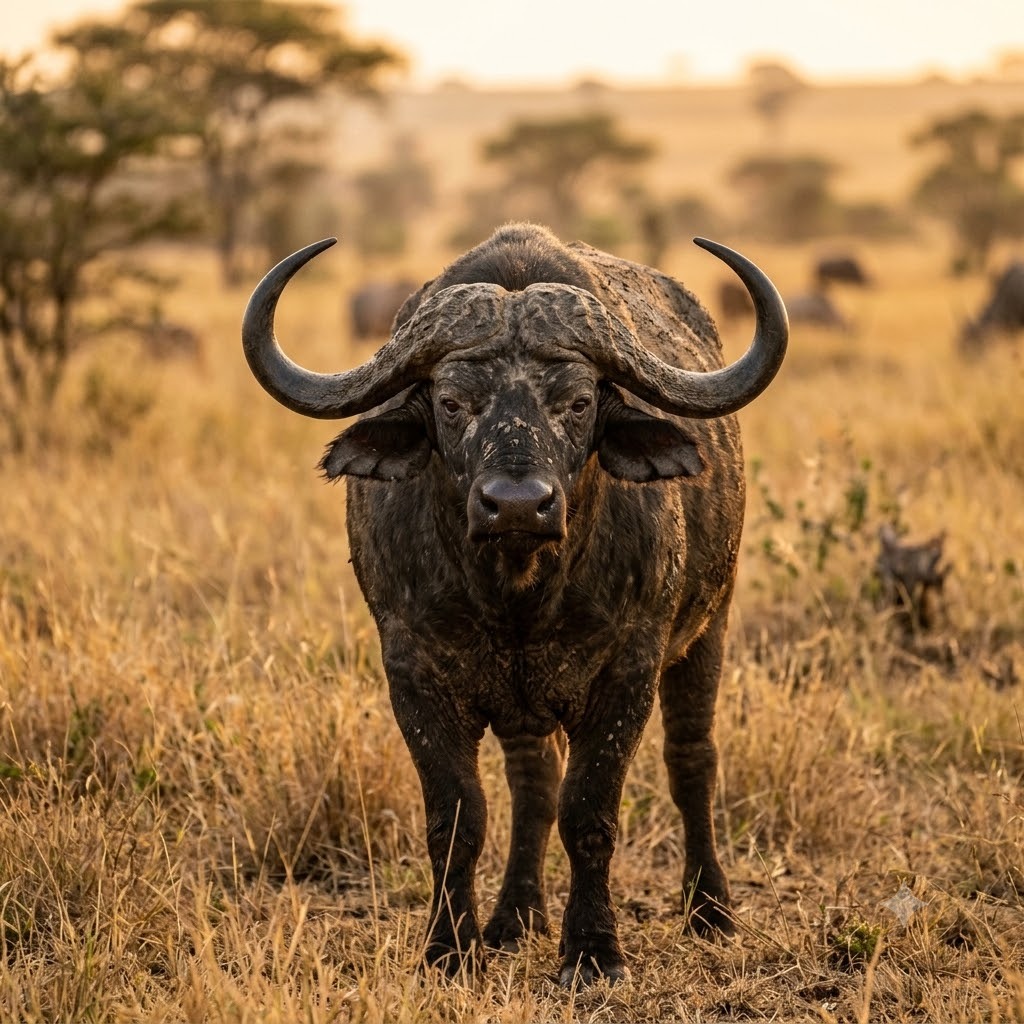
The Cape buffalo is the most dangerous of Africa's Big Five and the benchmark of dangerous-game hunting. A mature bull weighs 1,500 to 1,900 pounds, carries a heavy sweeping boss of horn, and has earned the nickname "Black Death" for the way wounded animals circle back on their pursuers.
Identification & Appearance
Bulls are near-black, thick through the neck and shoulders, and topped with a fused horn boss that hardens with age. Cows are lighter and reddish with thinner horns that do not meet in the middle. A hard, wide, worn boss is the mark of an old, shootable bull.
Range & Habitat
Cape buffalo range across the savanna, woodland and floodplain country of eastern and southern Africa, hunted mainly in Zimbabwe, Mozambique, Tanzania, Zambia and South Africa. They rarely stray far from water and favor thick riverine cover in the heat of the day.
Behavior & Sign
Buffalo live in large herds but old "dagga boys" split off in bachelor groups and are the classic trophy. They are unpredictable, superbly aware, and will hold in thick jesse until a hunter is close. Sign is obvious - broad tracks, cow-pat dung and wallows.
Hunting Seasons & Timing
Buffalo are hunted on the dry-season safari calendar, roughly April through October, when thinning cover and concentrated water make tracking possible. Cooler early and late hours are prime; middle of the day they bed in shade.
Hunting Methods
The standard method is tracking on foot behind a professional hunter and trackers, closing to bow or rifle range in thick cover. Baiting is not used; this is a spot, track and stalk game where the last thirty yards decide everything.
Gear & Optics
Law and ethics call for a heavy rifle - .375 H&H is the practical minimum, with .416 and larger common - firing soft points backed by solids. Add a low-power scope or express sights, sturdy boots and a wide-brimmed hat; shots are close and fast.
Shot Placement & Field Care
Aim for the heart-lung triangle low behind the shoulder on a broadside bull, and always be ready to follow up - buffalo soak up hits. Recovery, caping and salting are handled by the safari staff; the boss and cape are the prized trophy.
Meat & Eating Quality
Buffalo meat is lean, dense and beef-like, and in most concessions it feeds the staff, the village or the camp rather than being exported. Properly aged and slow-cooked it is excellent table fare.
Common Mistakes
The biggest errors are undergunning, rushing the boss-judgment, and failing to reload and stay ready after the first shot. A wounded buffalo is the reason experienced hunters treat every follow-up as a life-or-death situation.
Regulations & Conservation
Cape buffalo are hunted under strict CITES and country quotas; regulated trophy hunting funds anti-poaching and habitat across huge wild areas. This is a reading guide to a specialized international pursuit - always book through a licensed outfitter and confirm import rules with your wildlife authority. We do not give legal advice.
FAQ
Is Cape buffalo good for a first dangerous-game hunt? It is the classic entry to the Big Five, but only with an experienced PH and the right rifle.
Why the heavy caliber? Buffalo are heavily built and famously tough; the law and fair chase both demand adequate power.